Centralized Delivery Data Platform for Multi-Unit Restaurants
Summary Highlights
Unify all your restaurant’s delivery apps in one dashboard. Voosh.ai’s platform streamlines multi-location operations with real-time delivery analytics, automated reconciliation, and faster dispute resolution. Book a demo today!
How Multi-Unit Restaurants Can Streamline Delivery Operations with Centralized Data
Managing a chain of restaurants isn’t just multiplying one location’s headaches by ten-it creates a whole new level of complexity. Each location has its own orders, menus, staff, and financial quirks. Now add in third-party delivery apps (DoorDash, Uber Eats, Grubhub, etc.), each with separate dashboards, fees, and processes. It’s easy for revenue to slip through the cracks - especially when promotions or disputes aren’t handled consistently across all sites. In fact, Statista predicts the U.S. online food delivery market will reach $36.3 billion by 2025, so getting every penny right is crucial.
Multi-unit restaurants need centralized delivery intelligence: one place to see every order, every payout, and every review for every site. This article shows why consistency is vital for chains and how a platform like Voosh.ai brings all that data together. We’ll cover the unique challenges chains face and give clear steps to streamline operations, boost profits, and cut costs. Let’s dive in.
Why Are Multi-Unit Restaurants So Challenging to Manage?
Running a single restaurant is hard enough. For multi-unit owners, it’s a juggling act: different stores often have different challenges. One might be in a busy downtown where delivery peak is lunch, while another sits in a suburban plaza with steady dinner traffic. Staffing, menu preferences, and even local regulations can vary. Managing these differences manually leads to inconsistencies: a marketing campaign might roll out late, or a missing menu item isn’t updated in all locations.
The lack of real-time, unified data is a killer. As one industry study notes, if each store uses its own system, you won’t notice a drop in sales or a spike in labor costs until end-of-day reports. By then, problems have multiplied. Separate promotional strategies across locations can also backfire-what worked in New York might flop in Toronto.
For delivery specifically, the problem multiplies. Each chain location usually has separate merchant accounts with each app. That means multiple doorways into each delivery platform. Without coordination, one location might run a big coupon code push while another does nothing. Error rates (wrong orders, late deliveries) can differ wildly by site. The result? Customers get a hit-or-miss brand experience and operations become a nightmare.
A unified approach fixes that. Instead of logging into dozens of dashboards, a regional manager could open one Voosh.ai dashboard and instantly see key metrics for all locations at once. This consistency not only saves time, it can dramatically reduce costs: centralized systems cut duplication and waste. For example, many experts agree that standardizing core functions (like inventory or HR) across a brand brings uniform quality and fewer errors. We apply that same idea to the delivery side.
How Centralized Delivery Data Solves Chain Restaurant Problems
Imagine Lisa, who manages 10 burger joints. In the old world, she’d shuffle between ten tablets and spreadsheets. With centralized delivery intelligence, Lisa sees one bird’s-eye view. She can compare store to store: one location’s on-time rate, another’s commission fees, a third’s hottest-selling item. This cross-store insight is powerful. For instance, if one branch has a much higher cancellation rate, Lisa can send a specialist there or adjust staffing.
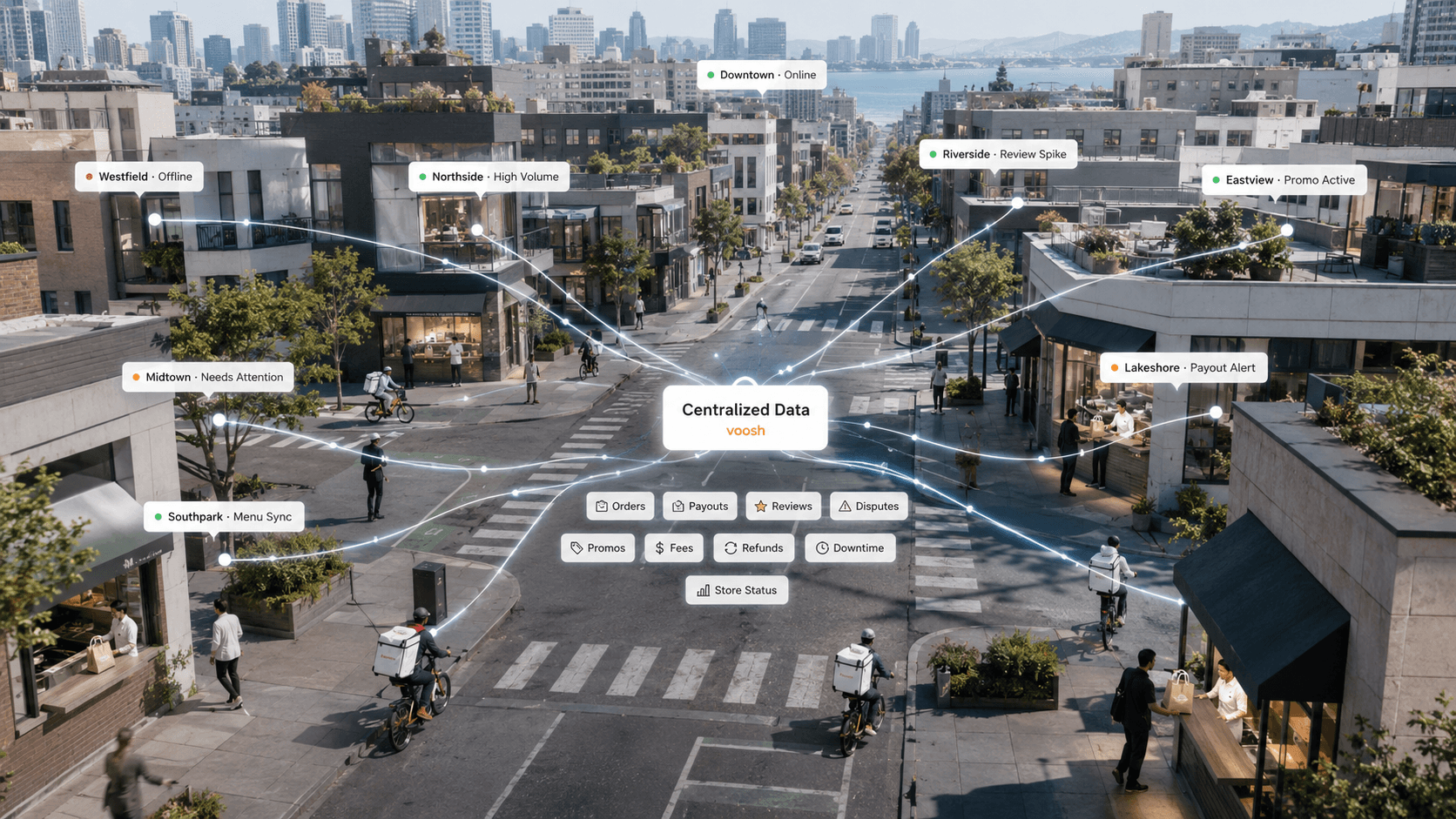
Key to this is a unified dashboard that aggregates data from all third-party platforms. All orders, disputes, promotions, reviews, and downtime incidents come into one place. Voosh.ai provides exactly this: it pulls in orders and payouts from DoorDash, Uber Eats, Grubhub, etc., and combines them with your internal data. That means chain managers no longer juggle separate apps. One click shows, say, “Total orders last week: 2,500; 200 disputes logged; $3,000 recovered in refunds” - across all restaurants.
Unified Dashboards for All Locations
With centralized data, a single dashboard becomes the chain’s command center. Instead of logging into each store’s accounts, operators use one portal. For example, at the start of the day a shift manager might see: “5 new reviews across all locations, 10 flagged for follow-up, average rating 4.2 stars”. That data drives action: maybe the chain notices a repeated complaint about packaging leaking. They can roll out a fix to all stores at once, rather than wait for it to surface individually.
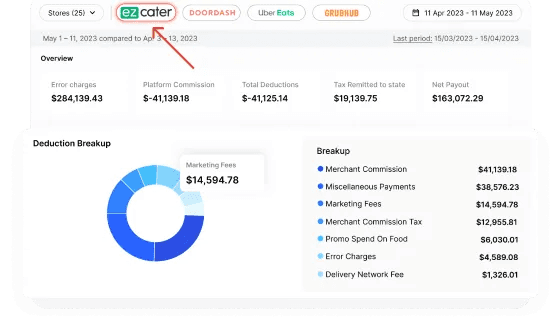
This unified dashboard also shows financial health chain-wide. A multi-location brand might have dozens of pending payouts from different apps. Voosh’s platform reconciles all of them automatically. If a store’s weekly statement is $10,000 but the restaurant only got $9,800, the missing $200 jumps out. For one large chain, consolidating reconciliation across stores has been a game-changer, preventing thousands in lost revenue.
Standardized Processes Across Outlets
Beyond data, chains win by standardizing workflows. Voosh.ai lets you define a chain-wide promotion or dispute policy. For instance, if the flagship test-run of a “free fries” promo on Wednesdays yields a 15% sales lift, you can activate the same deal for all locations with a couple clicks. Without centralization, each manager would have to replicate that, risking typos or inconsistent terms.
Similarly, the dispute resolution process can be uniform. One chain we know requires all teams to send evidence for every refund within 48 hours. The Voosh platform can enforce that workflow: automatic reminders ensure store managers aren’t missing deadlines. The result is a higher overall success rate-our data shows chains using Voosh recover up to 25% more lost revenue from order errors compared to treating disputes ad-hoc.
Key Benefits of a Unified Delivery Intelligence Platform
Centralizing your delivery data isn’t just a convenience-it delivers tangible benefits:
- Time Savings: One dashboard means one login. Multi-unit managers often spend hours each week toggling between apps and reports. We cut that time drastically.
- Higher Revenue Capture: Automated dispute handling across all stores means fewer missed refunds. Voosh users see revenue loss drop, directly boosting the bottom line.
- Better Customer Experience: With chain-wide review management, no comment goes unanswered. Faster responses across locations maintain brand reputation. (Templates for consistency are provided, whether a store has 5 or 50 outlets.)
- Improved Promotions ROI: Data-driven campaign rollout lets chains test promos at scale. One New York chain achieved a 19.9× ROI on promotional ads by using centralized insights to target the right markets.
- Consistent Branding: Every store follows the same pricing and menu across apps. Customers get predictable service; managers avoid confusion. As SynergySuite notes, “greater consistency” is a direct benefit of centralized tech.
In short, centralization turns big-chain complexity into a strength. Instead of 10 plates spinning, everything moves in sync under one platform.
Steps to Centralize Delivery Operations for Multi-Unit Success
1. Aggregate All Delivery Data: First, connect every location’s delivery accounts into Voosh.ai. This includes DoorDash, Uber Eats, Grubhub, etc., for every store. Voosh will then pull in orders, fees, and reviews automatically.
2. Set Up a Unified Dashboard: Create a chain-wide dashboard view. Configure it to display the top KPIs (sales, dispute wins, reviews) for each location side-by-side. Voosh’s interface lets you compare one store to another at a glance.
3. Standardize Your Playbook: Develop standard processes for common tasks. For example, use the same review-response templates chain-wide. Train staff at each location on the Voosh system so everyone follows the same steps for disputes, promotions, and downtime alerts.
4. Launch Chain-Wide Promotions: Plan your marketing at headquarters, then use the platform to push campaigns out to all stores. Monitor results by location in real time to adjust tactics. Voosh’s Promotion Manager makes it easy to replicate proven offers across units.
5. Monitor & Optimize Regularly: Have managers or HQ staff review the unified data at least weekly. Identify any outliers – for instance, if one location’s dispute rate is unusually high, investigate the cause (e.g. training issue, delivery partner problem). Use the data to continuously improve operations.
By following these steps, multi-unit operators turn data chaos into coherent strategy.
Conclusion – Unleash Your Chain’s Potential with Voosh
In today’s delivery-dominated market, chains can’t afford disconnected systems. A unified approach transforms delivery from a headache into a growth engine. Voosh.ai’s centralized platform gives multi-unit restaurants the visibility and tools to act quickly: win more disputes, optimize promotions, and maintain a strong reputation chain-wide. The result is healthier margins and happier customers.
Ready to see it in action? Book a demo with Voosh today and discover how your data can power smarter decisions – from New York to Vancouver.