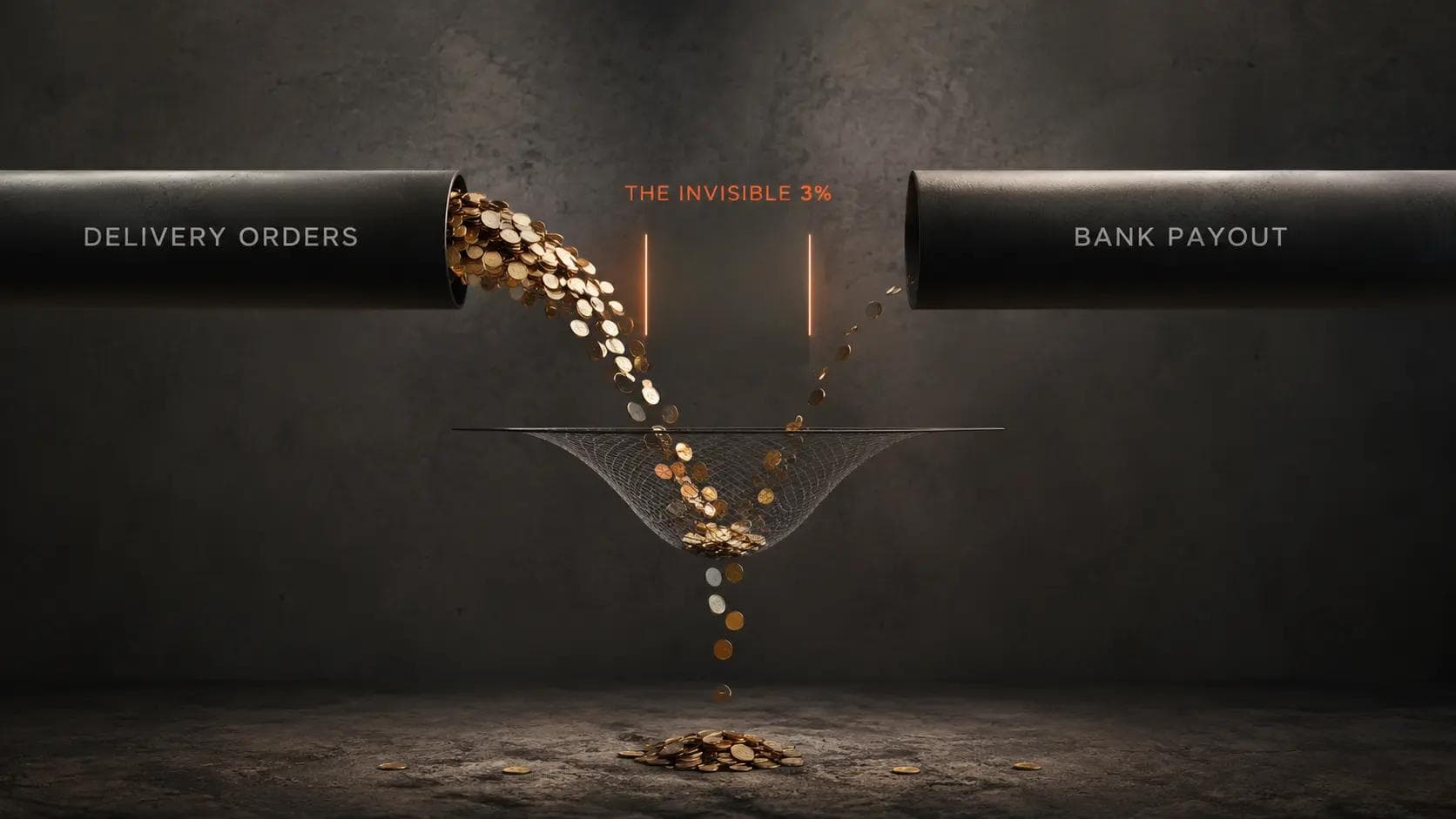
The Invisible 3%: Automated Delivery Commission Audits for Multi-Unit Brands
Summary Highlights
Stop losing 3% of delivery revenue. Voosh provides automated commission audits & reconciliation to recover missing payouts for multi-unit restaurants.
For a multi-unit restaurant operator, third-party delivery is a love-hate relationship. You love the volume; you hate the complexity of the "missing middle"- the space between an order being placed and the cash hitting your bank account.
Most CFOs and Controllers we speak with suspect they are losing money to marketplace errors. They’re right. Voosh internal data 2025 shows that multi-unit brands typically lose between 1.5% and 3.2% of their delivery revenue to commission overcharges, tax bifurcation errors, and unrecorded cancellations.
When you're doing $10M in delivery sales, that’s a $300,000 leak. Here is how to plug it.
Why Manual Auditing is a Losing Game
Most finance teams try to audit delivery payouts using a "sampling" method. They pick five orders from Tuesday at one location and match them against the DoorDash or Uber Eats portal.
But scaling this to 50 or 100 locations is impossible. The data is too fragmented. You have different commission rates for different brands, "error charges" for items you actually fulfilled, and tax amounts that don't align with your local nexus.
5 Common Leakage Points in Your Payouts
- Commission Creep: Being charged 30% when your contract says 25%.
- Tax Mismatches: Marketplaces remitting the wrong tax amount or failing to bifurcate taxes correctly between merchant and state.
- The "Ghost" Cancellation: An order cancelled by the customer after prep has started, but the marketplace fails to pay the merchant for the food cost.
- Hidden Error Charges: Fees for "missing items" that were never actually reported by the guest but were auto-deducted.
- Unclaimed Revenue: Orders that show as "Success" in your POS but never appear on a marketplace payout statement.
The 3-Step Forensic Reconciliation Framework
To stop the leak, you need a system that doesn't sleep.
1. Unified Data Aggregation
You cannot audit what you cannot see. The first step is to pull data from every marketplace (DoorDash, Uber Eats, Grubhub), your POS, and your bank deposits into a single source of truth.
2. Automated POS-to-Marketplace Matching
Every single order ID must be matched against a payout transaction. If an order exists in the POS but not the payout, that is "missing revenue." If the payout amount is lower than the POS order minus agreed-upon commission, that is an "overcharge."
3. Systematic Dispute Filing
Identifying the error is only half the battle. You must then file a dispute with the marketplace. This is where most teams fail because of the time required to gather evidence (screenshots, timestamps). Automating this recovery process is the only way to achieve 100% audit coverage.
How Voosh Automates the Audit
Voosh was built by operators who managed 200+ virtual brands. We knew manual spreadsheets wouldn't scale. Our platform connects directly to your marketplaces and POS to:
- Identify short-pays and missing payouts instantly.
- Auto-dispute bad charges with full evidence packages.
- Reconcile bank deposits to ensure the cash actually arrived.
Voosh Data 2025: Our partners see an average of 85% win rates on automated disputes, recovering millions in otherwise lost revenue.
Conclusion
If you are managing more than five locations, "sampling" your delivery payouts is no longer an option, it’s a liability. By moving to an automated dispute resolution, you’re not just saving time; you’re adding 2-3% directly back to your bottom line.
Book a demo if you’re curious about how Voosh can help your business.