Lower Your Order Cancellation Rate on Delivery Apps
Summary Highlights
Lower your order cancellation rate on delivery apps with store-status monitoring, faster issue response, and clearer ops signals. Book a Voosh demo today.
Off-premise is no longer a side channel. The National Restaurant Association’s 2025 trend data says about 75% of restaurant traffic now happens off-premises, and nearly 95% of consumers say speed matters in takeout and pickup. That means every canceled delivery order hits harder than it used to. It is not just one lost sale. It is a trust problem, a review problem, and often a visibility problem on the marketplaces that drive discovery.
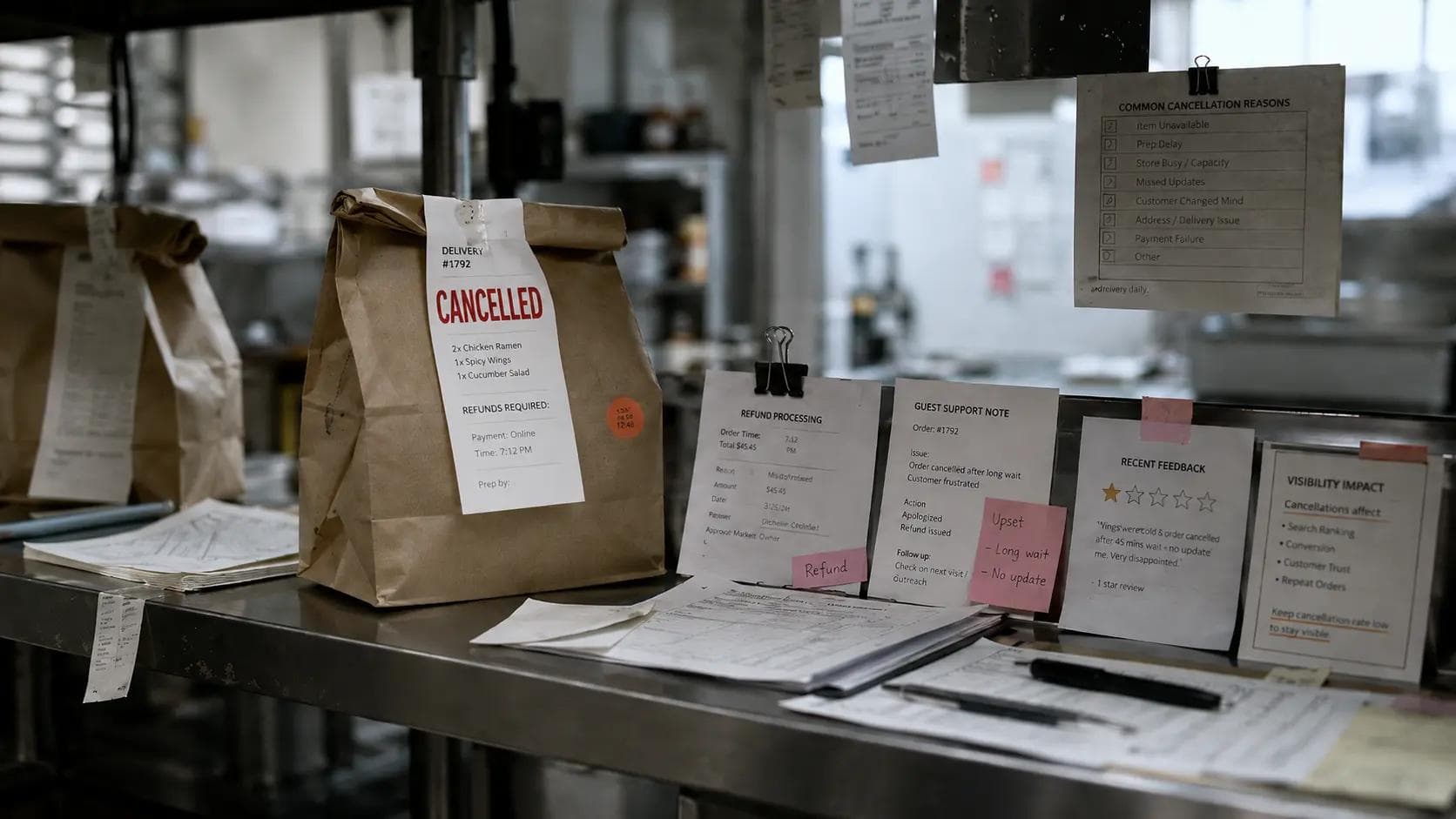
Order cancellation rate on delivery apps is the share of placed or accepted orders that never get fulfilled. For restaurants, it is more than a service metric. It is a revenue leak, a customer-trust problem, and a visibility risk because canceled orders often lead to refunds, complaints, and weaker marketplace performance.
If you run one store, canceled orders can quietly drag down weeknight sales. If you run fifty stores, they can hide inside store-level noise until they start showing up as lower conversion, more support work, and recurring complaints. That is why operators need a cancellation playbook, not just a dashboard.
Why canceled orders cost more than one lost ticket
The obvious cost is the order you did not keep. The less obvious cost is everything around it: guest frustration, refund handling, contact-center load, lower ratings, and lower repeat intent.
Marketplaces have made it clear that reliability matters. In Uber Eats’ publicly reported quality cleanup for virtual restaurants, the company required restaurants to keep at least a 4.3-star rating and fewer than 5% order cancellations to stay within program standards. That is not a universal threshold for every store type, but it shows the direction of travel: canceled orders are a quality signal, not just an operations inconvenience.
The platforms are also putting more weight on quality cues around the order itself. Uber Eats now uses AI around menu descriptions, food photos, review summaries, and live order chat, which means marketplaces are investing even more heavily in signals that shape guest confidence before and after purchase. If your store keeps generating canceled orders, that friction does not stay hidden for long.
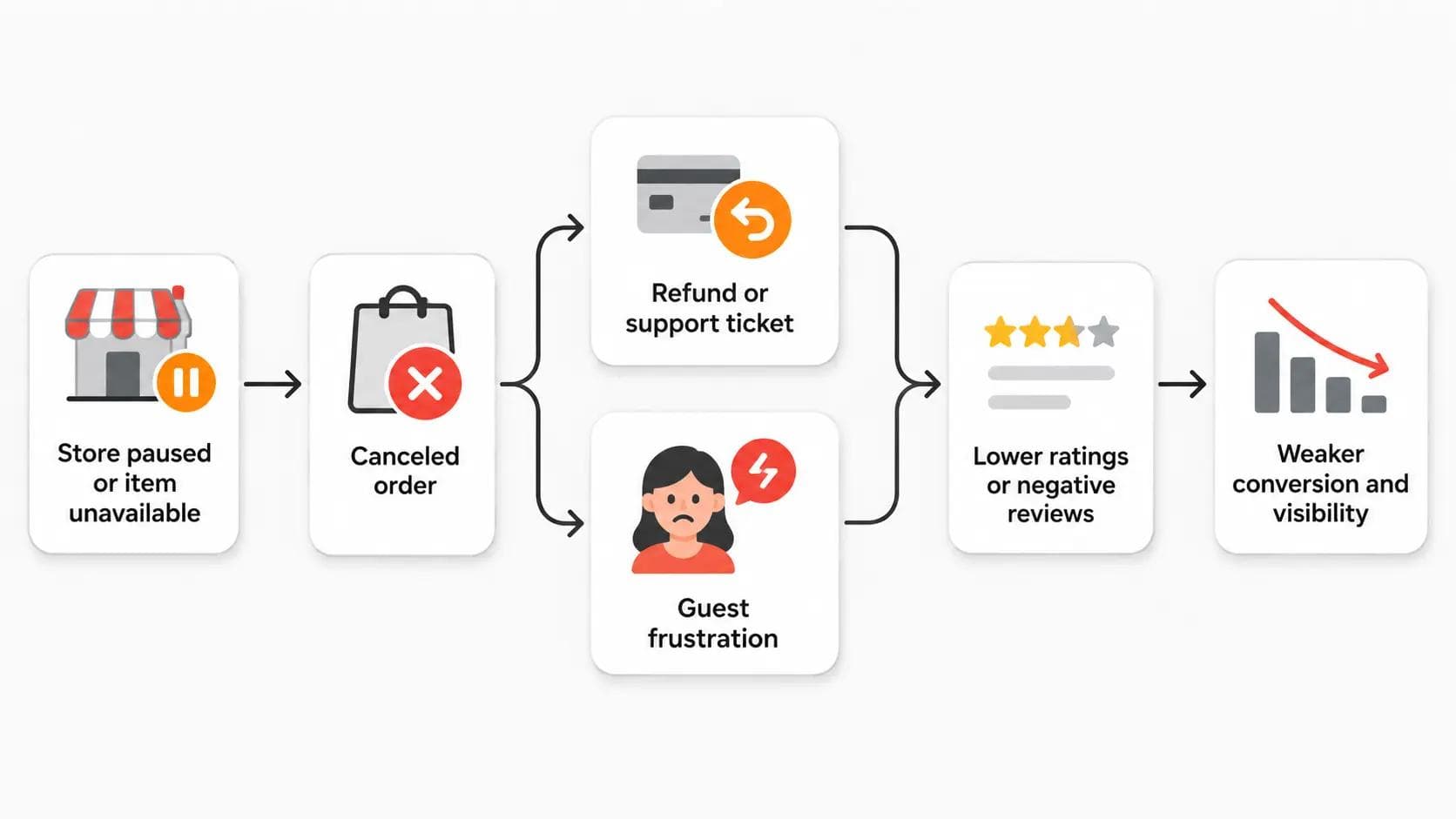
That snowball effect is why operators should not treat cancellations as “just another KPI.” They should treat them like an early-warning system.
Which cancellation causes should operators fix first
Not every cancellation has the same root cause. The fastest way to improve is to stop lumping them together.
Store-status failures
This is the cleanest starting point. If a store is offline, paused, or missing menu hours when it should be live, orders disappear before the kitchen ever has a chance to perform. Related product pages across the category make this plain: operators are being sold offline-store alerts, auto-reopen workflows, and issue notifications because this is a common and expensive failure point.
Voosh’s own materials put real weight behind this category. Product materials provided for this brief say Voosh processes more than 50 million marketplace signals monthly, analyzes more than $1 billion in delivery sales, and helps teams detect issues up to 30% faster. Separate product materials also cite 10 million-plus orders monitored and an 80-store franchise protecting up to 2% of monthly sales via store reopen coverage. That is why store-status failures should usually be fixed before deeper process tuning.
Item-availability failures
A store can be “online” and still be functionally broken if a guest can order items you cannot make. Stale hours, sold-out ingredients, disabled modifiers that did not sync, and menu edits that hit one marketplace but not another all create avoidable cancellations.
This is where many operators waste time. They treat availability as a manager-memory problem instead of a system problem. But category competitors now emphasize real-time item-availability updates and menu-sync controls for a reason: when availability drifts, cancellation risk rises immediately.
Prep-time and handoff failures
Some cancellations are really late-order problems in disguise. If prep-time estimates are too optimistic, the kitchen gets backed up, couriers wait, customers see long ETAs, and support conversations start. Fast service is already a consumer expectation on the off-premise side; if your operation misses that basic standard consistently, cancellations become more likely.
Bad menu logic
Restaurants often focus on food and forget menu logic. Missing modifier rules, unclear bundle structures, confusing substitution paths, and bad item mapping between POS and marketplace menus all create preventable errors. Those errors often end one of two ways: the store cancels the order, or the guest wants a refund after receipt. Neither outcome is good.
Communication failures
If an item is out, but the store can offer a quick substitute and confirm it in time, the order may still be saved. If the issue surfaces late, or no one closes the loop, the cancellation becomes almost automatic. The marketplaces are investing in merchant-customer communication tools for exactly this reason.
How do you lower your order cancellation rate in seven steps
Separate avoidable from unavoidable cancellations
Your first job is classification. Weather, courier shortages, or full-on system outages are not the same as stale hours, out-of-stocks, or bad prep promises. If the team uses one cancellation bucket for everything, nobody learns anything.
Build reason codes that let you split cancellations into:
- store offline or paused
- item unavailable
- wrong hours
- prep-time too long
- courier no-show or pickup delay
- customer-initiated
- duplicate or fraudulent order
The goal is not perfect taxonomy on day one. The goal is enough signal to stop guessing.
Fix offline-store and missing-hours failures first
If a store is unintentionally paused, or scheduled hours are wrong on one marketplace, that is low-hanging revenue recovery. It is also one of the easiest categories to automate.
This is where platforms like Voosh have a practical edge in the real world. Voosh data 2025 shows a product focus on store-status monitoring, signal detection, and automated corrective action. That makes uptime and hour integrity the first lever to pull because every other improvement depends on the store actually being sellable.
Turn item availability into a live operating motion
Do not wait for a line cook to shout that you are out of an ingredient after the order prints. For delivery, that is too late.
The healthiest operators make availability part of shift management:
- update 86’d items as soon as inventory moves
- review channel-specific availability at shift open
- check modifier groups after menu updates
- create fallback substitutions for top sellers
This sounds basic. It is. But basic discipline is often what separates a reliable listing from a frustrating one.
Tighten prep-time promises during rushes
Most operators know when their store is overloaded. The problem is that many do not translate that reality into the numbers customers see. If your prep promise stays flat while the kitchen backs up, you manufacture disappointment.
Your team should review prep-time ranges by daypart, weekday, and order mix. Dinner on Friday is not the same as Tuesday lunch, and family bundles are not the same as solo bowls. A realistic promise keeps more orders alive than an optimistic one that collapses later.
Clean up menu modifiers and edge cases
Cancellation prevention is often won in menu architecture. Audit the items that create the most support tickets and ask:
- Are required modifiers actually required?
- Are popular replacements available in-app?
- Are combo components mapped correctly?
- Are allergen or “no ingredient” instructions forcing manual workarounds?
If the same five items keep causing exceptions, the problem is rarely “staff execution” alone. It is usually menu design plus execution.
Use reviews and dispute data as an early-warning system
Most brands look at reviews after the damage is visible. That is too late.
In practice, cancellations start showing up in customer language before they show up in neat quarterly reports. Guests complain about unavailable items, late ETA changes, missing substitutions, or abrupt order drops. That is why reviews are operations data, not just brand-management data.
Voosh is well positioned here because its existing product materials emphasize reviews/reputation automation and large-scale marketplace signal detection. Used well, that means managers can spot a cluster like “store keeps canceling beverages after 8 p.m.” or “combo substitutions failing in one region” before the issue spreads.
Review cancellations by store, daypart, item, and marketplace every week
A single blended cancellation rate hides too much.
At minimum, review:
- store-by-store cancellation rate
- daypart trend
- top canceled items
- top cancellation reasons
- review phrases tied to canceled orders
- whether the issue is universal or marketplace-specific
That weekly drill is where a platform earns its keep. The point is not just to show the number. The point is to make the pattern obvious enough that a regional manager or operator can act without digging through six dashboards.
What should a real cancellation dashboard show every day
A useful dashboard does not just say, “Your cancellation rate is up.”
It should answer:
- Where? Which stores, not just which brands.
- When? Which dayparts and days.
- Why? Which reason codes and themes.
- What item? Which menu items or bundles are overrepresented.
- What else moved with it? Ratings, negative-review keywords, support contacts, refund pressure, and order volume.
Voosh’s product materials suggest this kind of multi-signal view is exactly where the platform is strongest. The materials provided in this brief describe signal processing at marketplace scale, cross-store issue detection, and live monitoring around store status, reviews, and performance trends.
That matters because cancellations rarely travel alone. If a store has elevated cancellations and also starts seeing review language around “closed when it said open,” “restaurant canceled,” or “out of stock again,” the operator does not need another generic analytics dashboard. They need a clean path from signal to action.
What does a healthy cancellation target look like
There is no one public standard that covers every restaurant type, geography, and marketplace model. But two practical benchmarks help.
First, if avoidable cancellations are regularly high enough that store managers already “know the problem,” the rate is too high. Second, if the number is hovering around or above one percent for reasons your team can control, treat it as urgent. That is not a formal marketplace rule. It is an operating rule.
Voosh’s own KPI article includes an example where 0.72% unfulfilled orders was already identified as a metric needing improvement in a chain environment. At the same time, Uber Eats’ public virtual-restaurant standards used fewer than 5% cancellations as a platform quality threshold. The lesson is simple: the formal platform threshold is not the standard you should aspire to. The better target is “low enough that the issue no longer shows up in guest experience, review sentiment, or visibility loss.”
That is why the smartest operators do not ask, “What is the acceptable cancellation rate?” They ask, “What is driving our avoidable cancellations, and how quickly can we close the loop?”
The bottom line
Canceled orders are one of the cleanest ways to lose revenue twice: once when the sale disappears, and again when customer trust gets weaker.
If you want a better cancellation rate, do not start with grand strategy. Start with operating discipline:
- keep stores truly live
- keep menus truly current
- keep prep promises honest
- keep issue detection fast
- keep reason codes usable
- keep weekly reviews store-specific
That is where Voosh can be genuinely useful. Not because “AI” is a magic word, but because teams need one place to catch the problems that tend to show up across marketplaces, stores, and dayparts before they become a recurring sales drag.
If canceled orders are quietly eating into your delivery channel, Book a demo and see what the signal looks like when it is finally in one place.