The Multi-Unit Guide to Reconciling Third-Party Delivery Payouts
Summary Highlights
Stop losing delivery profit to hidden fees. Learn the "three-way match" to reconcile DoorDash & Uber Eats payouts with POS sales for multi-unit restaurants.
If you run a multi-unit restaurant group today, third-party delivery is likely driving a massive chunk of your top-line revenue. But for finance teams, controllers, and franchisees, that revenue often feels like a black box. You see $50,000 in delivery sales on your Point of Sale (POS) system, but only $32,000 actually hits your bank account.
Where did the rest of it go?
Between baseline commissions, tablet fees, driver tips, customer refunds, marketing promos, and error adjustments, tracking every dollar from a DoorDash, Uber Eats, or Grubhub order is incredibly complex. When you multiply this complexity across 20, 50, or 200+ locations, the spreadsheet math breaks down.
In this guide, we are breaking down exactly how to reconcile third-party delivery payouts, where the hidden profit leaks usually occur, and how modern restaurant operators are automating the process to recover millions in lost revenue.
What Is Third-Party Delivery Reconciliation?
Third-party delivery reconciliation is the accounting process of matching the actual cash deposits hitting your restaurant's bank account with the original gross sales recorded in your POS system and the detailed payout reports provided by the delivery marketplaces.
In a perfect world, this process ensures that every deduction taken by a delivery app is accurate, authorized, and accounted for in your general ledger. In reality, it is a tedious investigative process used to uncover overcharges, missed payouts, and invalid chargebacks.
Why Manual Reconciliation Is a Nightmare for Multi-Unit Brands
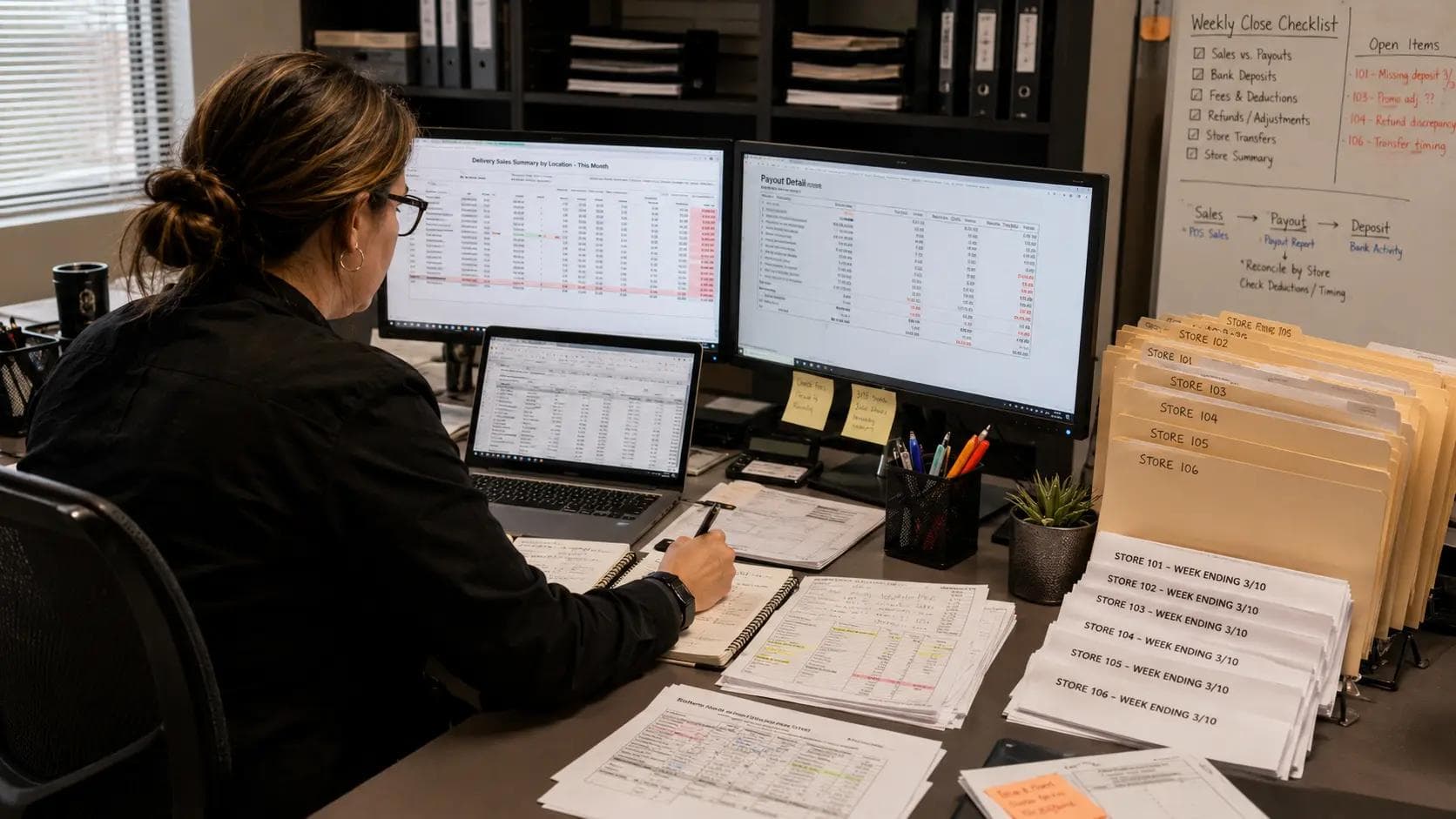
If you run a single independent restaurant, your bookkeeper might be able to log into a delivery merchant portal, download a CSV, and match it against the bank feed on a Sunday afternoon. For a multi-unit brand, manual reconciliation is an absolute nightmare that burns hundreds of administrative hours.
Here is why the traditional spreadsheet approach fails at scale:
The "Three-Way Match" Problem
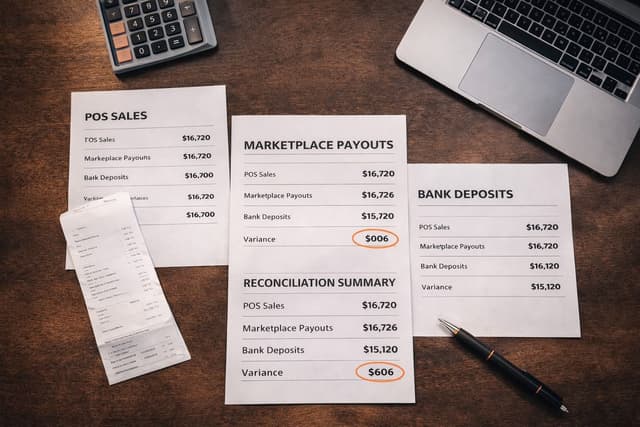
To accurately audit a delivery payout, your accounting team must perform a three-way match. They need the POS data (what was ordered and the gross total), the marketplace portal data (what the app says they owe you after their cut), and the bank statement (what actually cleared).
Because payout schedules differ, some apps pay out weekly, others daily, and they often batch deposits for multiple stores together, matching a specific transaction to a specific bank deposit becomes a grueling game of financial needle-in-a-haystack.
The Trap of Hidden Deductions and Adjustments
Delivery platforms don’t just deduct a flat 20% or 30% commission. The payout reports are riddled with line items that don't always map cleanly to your POS. A payout might be reduced by a $15 tablet fee for one store, a $50 marketing promotion for another, and $120 in customer refunds across three different locations. If your team isn't digging into the granular transaction-level data, you are likely writing off thousands of dollars a month as a generic "cost of goods sold" or "delivery fee" without actually verifying if the deductions were valid.
Step-by-Step: How to Reconcile Third-Party Delivery Payouts
If your team is still managing delivery finance and reconciliation manually, you need a rigid Standard Operating Procedure (SOP). Here are the exact steps your accounting team should take to reconcile third-party delivery payouts on a weekly basis:
- Export Gross Sales from the POS: Pull a detailed report of all third-party delivery orders logged in your POS for the given payout period, segmented by location and marketplace.
- Download Marketplace Payout Reports: Log into the merchant portals for every delivery app and download the transaction-level payout CSVs.
- Align the Timeframes: Adjust for cutoff times. A delivery app’s "financial day" might end at 2:00 AM, while your POS ends at midnight. Ensure you are comparing the exact same batch of orders.
- Isolate the Baseline Commissions: Calculate the agreed-upon commission percentage against the gross subtotal to verify the platform is honoring your contracted rate.
- Separate Non-Commission Deductions: Categorize all other deductions: customer refunds, missing item chargebacks, tablet fees, sponsored listings, and driver tips (which pass through).
- Cross-Reference Refunds and Cancellations: Audit the refund line items. Did the customer cancel the order after the food was already prepared? If so, you may be eligible to dispute that deduction.
- Verify the Final Bank Deposit: Match the net payout calculated from the marketplace report to the actual lump sum deposited into your corporate bank account.
- File Disputes for Discrepancies: If you identify invalid deductions (like an unmerited "order not received" chargeback), immediately log back into the portal to file a dispute with your evidence.
The Most Common Discrepancies (And Where Your Money is Hiding)
When teams start looking closely at transaction-level data, they almost always find leaks. Based on Voosh data (2025) spanning over a billion dollars in processed delivery sales, here are the most common areas where restaurants lose money.
Unreported Cancellations and Refunds
This is the single biggest profit killer in delivery. A customer reports a missing item, or claims their food arrived cold, and the delivery platform automatically issues a refund. This amount is quietly deducted from your next payout. Often, these refunds are unjustified, or they are the fault of the delivery driver, not the kitchen. If you aren't reconciling daily, the tight window to dispute these chargebacks (often 14 to 30 days) expires, and that revenue is lost forever.
Marketing and Promotion Deductions
If your brand runs promotions on the apps, like "Spend $25, Save $5" or sponsored placement, those costs are deducted directly from your payouts. However, tracking the ROI of these campaigns is notoriously difficult if the marketing deductions are lumped in with standard commissions. Proper reconciliation separates ad spend from operational fees, giving your marketing team a true picture of customer acquisition costs.
Tablet and Activation Fees
Franchisees frequently find themselves paying monthly tablet or software subscription fees for stores that have been closed, or for tablets that were returned months ago. Over a 50-location group, a phantom $15 weekly fee adds up to thousands of dollars in wasted capital over a year.
How Automation Recovers Millions for Restaurant Operators
The reality is that hiring more accountants to stare at spreadsheets is not a scalable solution for multi-unit franchise groups. The volume of data is simply too large.
This is why leading brands, including massive multi-unit franchises like McDonald’s, Papa Johns, and Dairy Queen, have shifted to an intelligence and automation layer to handle their finances.
Moving from Spreadsheets to Real-Time Financial Intelligence
Instead of waiting until the end of the month to realize a payout was short, modern operators use automated platforms that integrate directly with their POS and marketplace APIs.
With an automated delivery dispute automation system, the software performs the three-way match instantly. It flags any discrepancy between the POS and the payout, isolates exactly which store and which order caused the issue, and tracks the exact net profit.
More importantly, it moves beyond just reporting the lost money. When an invalid chargeback is detected, the platform can automatically gather the evidence (timestamps, POS receipts) and file the dispute on your behalf. For operators managing 50+ stores, this eliminates hundreds of hours of manual portal-hopping while recovering revenue that was previously written off.
Furthermore, if a store experiences delivery app downtime, causing an unexpected drop in gross sales for the day, automated systems can correlate that downtime directly to the financial reports, giving operators total visibility into the health of their delivery business.
Stop the Quiet Leaks
You cannot manage what you do not measure, and you certainly cannot protect profits you aren't tracking. Reconciling third-party delivery payouts is no longer an optional end-of-month accounting chore; it is a mission-critical operation for protecting restaurant margins.
Ready to see exactly how much revenue is hiding in your delivery payout data? Book a demo today and let our team run a free profit audit on your marketplace accounts.