
Restaurant Delivery Fees Explained
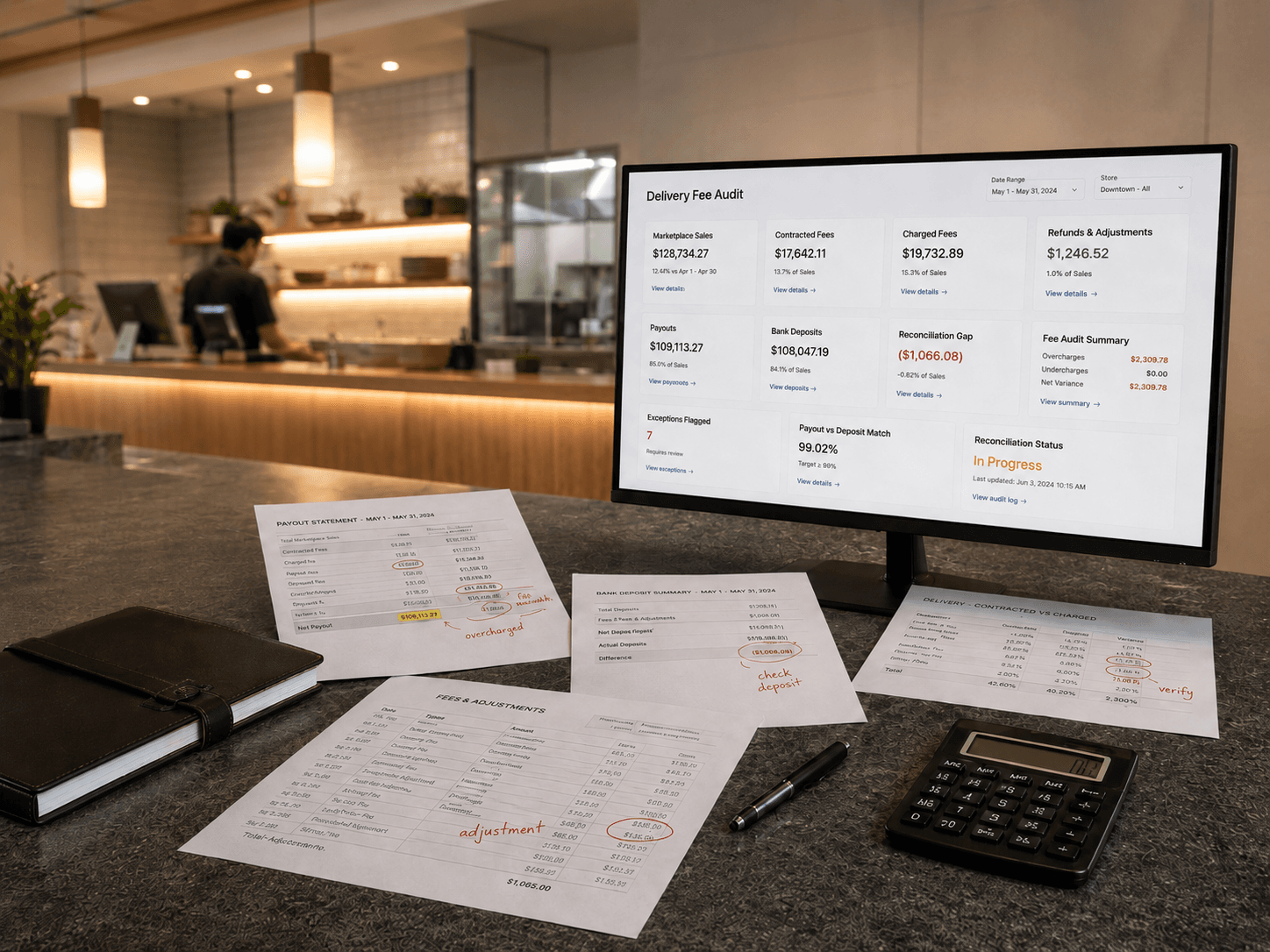
Summary Highlights
Uncover what’s really eating your delivery revenue. Learn to audit commissions, adjustments and other fees, and see how Voosh helps you recover profit.
If delivery is a real revenue channel for your restaurant, delivery fees are not a side issue. They are a margin issue.
Nearly 75% of restaurant traffic now happens off-premises, and 58% of limited-service operators plus 41% of full-service operators say off-premises makes up a bigger share of sales than it did in 2019. That means more orders are moving through marketplace fee structures, payout rules, and post-order adjustments that can quietly eat take-home if nobody is checking the math.
Restaurant delivery fees are the full set of charges and deductions that reduce what a restaurant keeps from a delivery order. That stack can include commission, pickup or self-delivery fees, ad or promo spend, refunds, adjustments, chargebacks, and payout timing differences. If you only watch gross sales, you miss the real margin story.
The hard part is that most operators do not lose money through one giant obvious charge. They lose it a little at a time. A plan mismatch here. A promo line item there. A pickup fee that changed. A refund that lands later and never gets tied back to the original order. Over time, those leaks become “delivery is busy but somehow still feels light.”
This is also becoming a bigger public issue. In April 2026, the Federal Trade Commission, asked for public comment on unfair and deceptive fee practices in online food and grocery delivery, after prior enforcement around hidden or misleading fees. For restaurant operators, that is a strong signal: delivery fee structures are complicated enough that even regulators think they deserve a closer look.
See the full fee stack in plain English
The fastest way to understand restaurant delivery fees is to stop treating “commission” as the whole story.
Here is the plain-English version:
- Base marketplace fee or commission : the core percentage charged on the order.
- Pickup / self-delivery fee : usually lower than full marketplace delivery, but still not free.
- Ads and promo funding : optional on paper, but often necessary if you want visibility.
- Refunds, order-error charges, amendments, or adjustments : the lines that usually show up later.
- Processing or service mechanics : sometimes explicit, sometimes baked into marketplace fee structures.
- Packaging and make-good costs on your side : not marketplace fees, but still part of what delivery really costs you.
That is why “what do delivery apps charge?” and “what did we actually keep?” are two different questions. One is a pricing-page question. The other is a finance question.
Why do delivery fees feel bigger than the advertised rate?
Because the advertised rate is only the front door.
Platforms publish simple headline pricing because it is easy to buy. Operators experience a messier total because real delivery economics include visibility costs, order-quality credits, adjustments, and timing gaps. That is why so many finance teams end up staring at three numbers that do not agree: POS sales, marketplace payout totals, and what actually hit the bank.
There is also a customer-side pressure problem. A 2025 LendingTree study found, delivery costs consumers nearly 80% more than pickup on average. In other words, restaurants do not have unlimited room to keep marking up menus to absorb delivery costs. Eventually the customer notices, conversion drops, and your brand takes the hit.
That makes fee control more important than fee-shifting. The better long-term move is not “just raise everything 20%.” It is knowing exactly which fees are contractual, which are optional, which are avoidable, and which need a tighter audit loop.
What do restaurants really pay across major marketplaces?
The official pricing pages matter because they tell you the starting rules. But they do not tell you the whole take-home story.
How does DoorDash price delivery and pickup?
On its current merchant pricing page, DoorDash offers three marketplace tiers. The Basic plan lists delivery at 15% and pickup at 6%. Plus lists delivery at 25% and pickup at 6%. Higher-visibility plans reach 30% on delivery. That is the clean headline, and it is useful as your “expected rate” starting point.
What that does not answer on its own is whether your stores are all on the same plan, whether promo spending is being separated cleanly from commission, or whether one group of stores drifted into a different setup after an operational change. That is exactly why a rate audit matters.
How does Uber Eats price delivery and pickup?
Uber Eats merchant page says U.S. marketplace fees changed in 2026. Delivery orders are now listed at 20% for Lite, 25% for Plus with 30% for Uber One member orders, and 30% for Premium. Pickup is 7% if in-store pricing is validated, otherwise 10%. Uber’s merchant help also explains separate delivery models where marketplace delivery, self-delivery, and pickup carry different fee structures.
That means an operator cannot afford to say “Uber charges us 25%” and stop there. The real answer may differ by order type, member status, pickup validation, or store configuration.
How does Grubhub structure plans and delivery?
Grubhub’s pricing page positions its marketplace plans as marketing commissions starting at 5% for Basic, 15% for Plus, and 20% for All-Access, while delivery fees can start at 10% when you use the marketplace fleet. It also calls out that additional fees, including order processing fees and delivery fees where applicable, can apply.
That is a good reminder that “commission” labels alone can be misleading. Some platforms present one bundled rate. Others separate exposure, delivery, and other cost layers. If you compare platforms without normalizing the full stack, you can make the wrong decision fast.
Spot the hidden costs that quietly erase margin
The most common mistake operators make is focusing on the headline commission and missing the quiet lines that do the real damage.
The first hidden cost is promo drift. You might be comfortable with your marketplace plan, but if ad spend and promo funding are not being reviewed by store and channel, your effective take rate rises without a clean internal conversation. On the Voosh ads and promotions page, the company frames this clearly: operators need visibility into ROAS, cost per order, and payout lift by store and channel, not just top-line order counts.
The second hidden cost is refund and adjustment lag. By the time finance sees a deduction, ops may be two weeks removed from the order that triggered it. That breaks accountability. It also makes real root-cause work much harder than it should be.
The third hidden cost is store-to-store inconsistency. Multi-unit teams often assume every location is running the same agreement and behavior. In practice, one store may be over-discounting, another may show a different pickup setup, and a third may simply be generating more quality-related deductions. If all you review is brand-level delivery sales, that drift stays hidden.
The fourth hidden cost is lost audit time. Even when the fees are not “wrong,” teams often spend too many hours proving that they are right. That time has a cost too.
Audit restaurant delivery fees in seven practical steps
If you want a clean operating rhythm, use this as your monthly fee-audit checklist.
1. Pull the source-of-truth terms.
Gather each marketplace agreement, pricing confirmation, and any store-specific exceptions. Write down the expected logic by channel: delivery, pickup, self-delivery, and promo participation.
2. Export orders, payouts, and statements for the same date range.
Do not compare a weekly sales file to a monthly statement and expect clean answers.
3. Separate commission from everything else.
Break out base marketplace fees, ads, promotions, refunds, amendments, adjustments, and chargebacks so nobody is arguing with a blended blob.
4. Calculate effective fee rate by store and channel.
The simple version is total marketplace deductions divided by order subtotal. Run it by store, by week, and by marketplace.
5. Flag outliers.
Look for stores with higher effective rates than the group, sudden shifts after a date, or unexplained promo-heavy periods.
6. Tie payouts to bank deposits.
Until cash is matched, you still do not have the whole answer. This is where many teams discover “we thought this was a fee issue, but it is actually a payout timing issue.”
7. Escalate mismatches with evidence.
Use store ID, payout ID, date range, expected rate, actual rate, and variance dollars. Send proofs, not frustration.
That is the manual workflow. At scale, the smarter move is to automate as much of it as possible.
Protect take-home with better delivery intelligence
This is where Voosh can credibly come into the story, without hype.
On the live finance product page, Voosh says its finance and reconciliation workflow connects POS, marketplace, and bank data, matches orders to deposits, surfaces short-pays and missing payouts, and exports clean entries to accounting. It also highlights a Marketplace Charges Mapper and Marketplace Commission Auditor inside the finance suite.
That matters because fee control is not just about spotting a bad rate once. It is about building one place where finance, ops, and leadership can answer the same question from the same data.
Voosh’s public proof stack also gives this story weight. The finance page says teams using the product have reconciled more than $1.02B in sales to date, matched 11.4M orders, and recovered $10.7M from variances. A current success story for an 80+ location Wendy’s franchise says the team reconciled $3M in third-party delivery sales in a month, itemized $520K in deductions, surfaced $27,880 in error charges, and protected more than $20,000 in one month by catching and challenging bad fees.
If you are an independent operator, the lesson is simple: you need one reliable monthly audit motion. If you are multi-unit, the lesson is stricter: you need auditability by store, by marketplace, and by payout batch, or fee drift becomes inevitable.
A good internal benchmark is this: your team should be able to explain gross marketplace sales, total deductions, net payout, and open recovery items in under 10 minutes. If you cannot do that, the problem is not only “high fees.” It is low visibility.
“restaurant payment reconciliation”
“third party delivery reconciliation playbook”
The goal here is not to eliminate every marketplace cost. The goal is to separate normal cost from preventable leakage, and then fix the preventable part fast.
If you want one place to reconcile payouts, audit commission logic, spot bad deductions, and connect finance with marketplace performance, book a demo with Voosh.
Catch up on other editions

Ghost Kitchens vs Multi-Unit Restaurants: Maximizing Profits with Voosh's Restaurant Marketplace Intelligence Platform

Increase Your DoorDash Sales with Voosh.ai's Promotion Manager