Restaurant Profit Margin on Delivery Apps
Summary Highlights
Restaurant delivery sales can grow while profits stay flat because third-party apps add commissions, promo costs, refunds, packaging expenses, and payout inconsistencies on top of already-thin restaurant margins. True delivery profit margin measures what restaurants actually keep after all deductions, not just app sales. Platforms like Voosh, help operators track payouts, audit commissions, monitor downtime, analyze promotions, and uncover hidden revenue leaks so delivery growth translates into real profitability.
Restaurant Profit Margin on Delivery Apps
If your delivery sales are climbing but cash still feels tighter than it should, you are not imagining things. Off-premises now accounts for nearly 75% of restaurant traffic, and consumers still want more delivery and takeout. But average restaurant net margins remain thin, with public benchmarks commonly landing in the 3%–9% range. When third-party delivery fees can run 15%–40%, it does not take many fee leaks, payout errors, or weak promotion decisions to turn “growth” into margin pressure.
Restaurant profit margin on delivery apps is the percentage of each delivery dollar you keep after food, labor, marketplace commissions, promo spend, packaging, refunds, and payout variances are accounted for. It is not the same as gross sales, app-reported payout, or order count. It is the cleanest way to answer one question: Is delivery actually paying off?
Why do delivery sales rise while take-home stays flat?
The short answer is simple: delivery adds revenue, but it also adds layers of cost and variability that are easy to miss. A normal restaurant margin is already tight. So when commission fees, promo spend, processing fees, packaging, refunds, and adjustments stack up on top of each other, the business can get busier without getting meaningfully more profitable. That is one reason cities such as Philadelphia, Pennsylvania have made fee caps an operator issue, and one reason the Federal Trade Commission is now seeking public comment on potentially unfair or deceptive food-delivery fee practices.
There is also a reporting problem. Marketplace “sales” do not equal cash in the bank. Deposits are batched. Marketing can sit in a different bucket than commissions. Amendments and adjustments can land after the original order date. And if one store is down, running the wrong plan, or overspending on promos, the margin story can drift by location without anyone noticing until month-end.
What is the restaurant profit margin on delivery apps?
Here is the practical operator definition:
Restaurant profit margin on delivery apps is the percentage left after you subtract all direct delivery-related costs and all marketplace-related deductions from delivery revenue, then compare what remains to the original delivery sales figure.
That matters because delivery decisions should be made with take-home visibility, not just sales optimism. A location can look busy inside the app while quietly bleeding margin through wrong commissions, marketing drift, downtime, or unresolved error charges. If you only review gross sales, you will miss the real picture.
Calculate delivery margin without spreadsheet chaos
The cleanest workflow is not “sales minus some fees.” It is:
1. Pull gross delivery sales by store and by channel.
2. Match orders to marketplace payouts.
3. Match payouts to bank deposits.
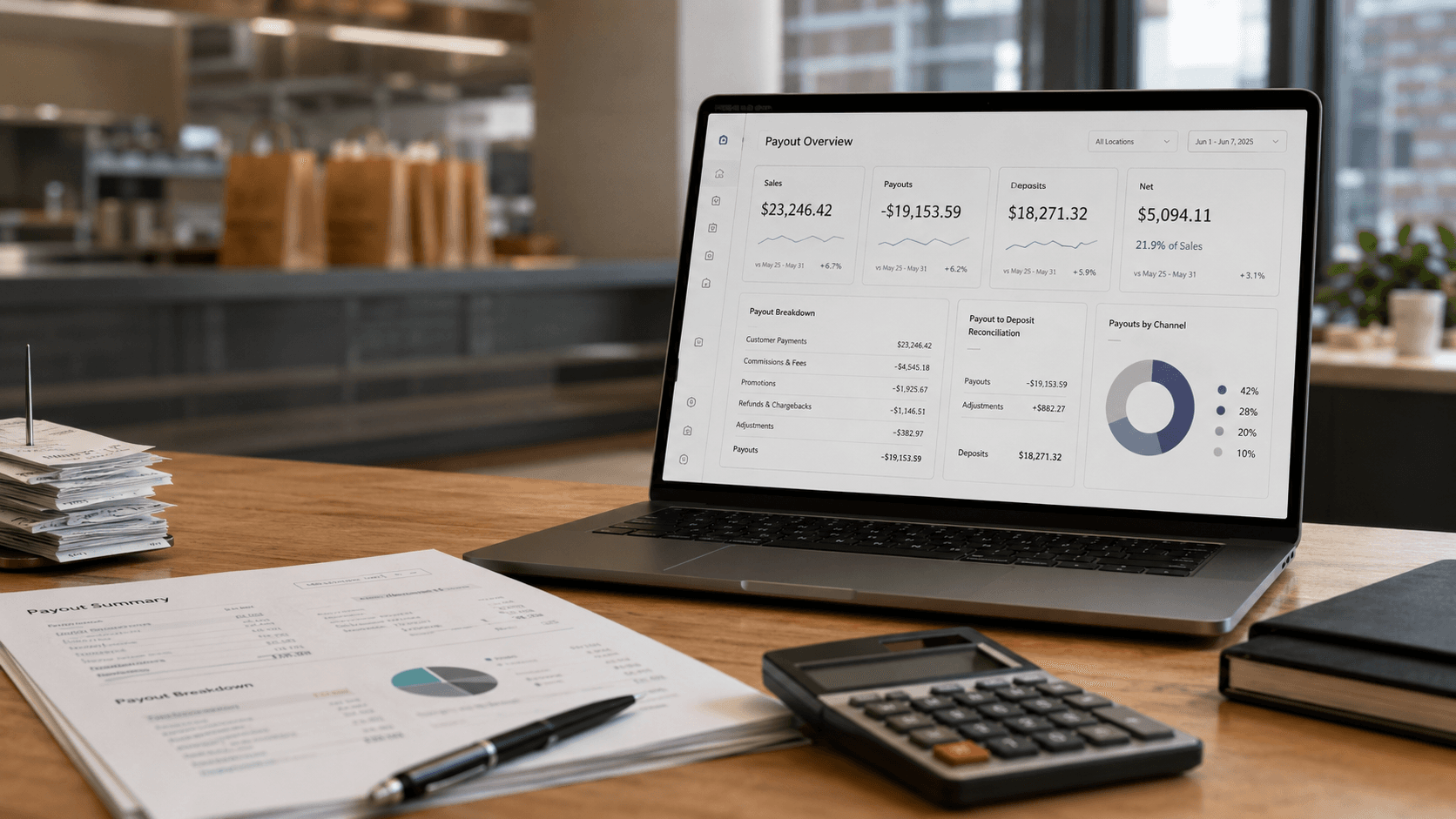
4. Separate commissions and fees, marketing spend, refunds, and adjustments.
5. Add direct delivery costs such as packaging and any channel-specific labor you track internally.
6. Review all exceptions by store every week.
A practical formula looks like this:
Delivery margin % = (Net payout - direct delivery costs - unresolved invalid charges) ÷ gross delivery sales
The exact cost lines will vary by operator, but the principle stays the same. Do not force deposits to equal sales on the same day. Reconcile to deposits, use a clearing-account mindset, and make every difference explainable. That is the only version that scales once you have more than a few stores.
If you want the fastest improvement, stop treating delivery as one blended number. Break it down by store, week, and marketplace. The store-level view is where rate mismatches, spend drift, and operational breakdowns become obvious.
Find the leaks that quietly kill margin
Most delivery margin loss is not one giant disaster. It is a stack of smaller leaks.
Commission drift by store
One store may be on the wrong plan. Another may have a pickup-versus-delivery mix that changed. Another may be carrying marketing deductions nobody expected. Voosh’s own DoorDash audit playbook points out that plan or tier mismatches, marketing spend, amendments, and reporting-window differences are common reasons payouts fall short of expectations.
Promo spend without a payout lens
Promo and ad dashboards look healthy when sales rise, but sales alone are not the goal. Voosh’s promotions page explicitly frames performance around ROAS, cost per order, and payout lift by store and channel. In one 7-unit fast-casual bagel case study, tighter marketplace roles, budget control, and payout-based optimization helped the brand add $13K in monthly payout value within 3 months and reach 9.6X ROI. That is the right lens: not vanity sales, but better take-home.
Invalid charges that should have been disputed
Voosh’s dispute workflow is built around spotting bad charges, bundling evidence, and tracking recovered dollars. That matters because unresolved invalid fees are not “the cost of doing business.” They are avoidable margin loss. On the finance side, one 50-location burger chain case study says Voosh reconciled $1.42M in marketplace sales and surfaced $353.77K in deductions in 30 days. If you do not surface the variance, you cannot challenge it. If you do not challenge it, it becomes permanent margin erosion.
Downtime you never counted as a margin issue
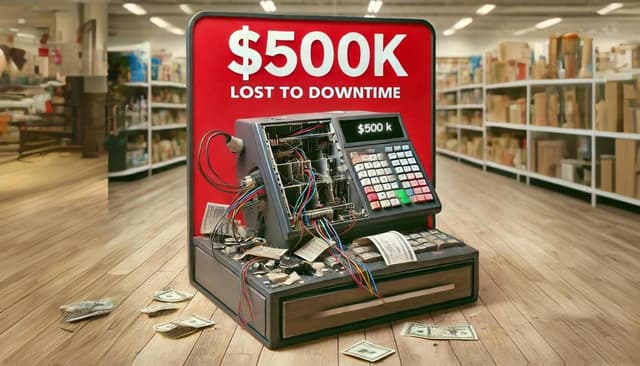
Stores going offline are often treated as an ops problem, but they are also a margin problem because lost hours mean lost contribution. Voosh’s uptime product page says operators can see store status in real time, quantify revenue protected, and auto-reopen locations. One 40-location operator case study says Voosh auto-reopened stores 2,346 times, saved 142 hours 23 minutes of downtime, and protected an estimated $15.3K in revenue in 30 days.
Review drag that quietly reduces marketplace visibility
Bad reviews do not just hurt brand perception. They can also reduce conversion and visibility across delivery and local search channels. Voosh’s reviews product centers on one inbox across major channels, plus brand-safe AI drafts and trend surfacing. Voosh data 2025: in a published Voosh playbook spanning 5,000+ restaurants, negative reviews fell 25% in 45 days; in one DMA, ratings moving from 4.1 to 4.4 corresponded with 18% more DoorDash impressions and 9.7% net delivery revenue growth. Margin protection is not only finance. It is also reputation.
Make delivery margin a weekly operating habit
A lot of operators wait for the monthly close to ask hard questions. That is too late.
A better rhythm looks like this:
- Start of week: match last week’s payouts to deposits and clear obvious exceptions.
- Midweek: review commission outliers, unusual amendments, and any marketing spend that looks off.
- End of week: log unresolved issues by store, then escalate anything that should be disputed or investigated.
Keep the exception list short. Timing difference. Unexpected deductions. Refunds and post-period adjustments. Cancelled-order inconsistencies. Invalid charges. Downtime impact. Data-mapping issues. If your team has 20 variance reasons, you will never get through the work. If it has 5 to 7 clean buckets, the problem becomes manageable.
This is where independent and multi-unit operators split a bit.
For a smaller operator, a weekly spreadsheet and a disciplined bank-match process can go a long way.
For a multi-unit brand, that tends to break quickly. Too many stores. Too many line items. Too many exceptions. That is when automation stops being “nice to have” and starts becoming the only way to stay consistent.
See where Voosh fits into the workflow
Voosh is most useful when you think of it as a delivery-margin operating system, not just one dashboard.
Its Finance and Reconciliation product is built to connect POS, marketplace, and bank data, trace orders to deposits, surface differences, and export clean entries to accounting. The Platform Commission Auditor validates charges against contracted rates. Marketplace Dispute Automation flags invalid charges and files with evidence. Marketplace Store Uptime monitors store status and can auto-reopen eligible downtime incidents. Ads & Promotions Analytics measures ROAS, cost per order, and payout lift. And VooshGPT sits over the whole system so teams can ask plain-English questions about sales, uptime, reviews, disputes, payouts, and promotions from one place.
That matters because the real delivery-margin problem is cross-functional. Finance sees the payout gap. Ops sees the downtime. Marketing sees the promo spend. Reputation sees the reviews. Leadership sees the blended number and asks why profits are not following sales. The more disconnected those views are, the slower the response. Voosh’s value is that it brings those signals into one operating model.
Protect margin before it disappears
The biggest mistake in delivery is assuming a healthy top line means a healthy take-home. It does not.
What protects margin is simple, but not easy:
- know your true net by channel
- match payouts to deposits
- challenge the charges that do not belong
- measure promo spend against payout, not clicks
- treat downtime and reviews as revenue issues, not side issues
If your team wants a cleaner view of where delivery dollars are getting lost and what to do about it, book a demo and walk through your margin workflow store by store. That is usually where the hidden revenue starts to show up.