Third-Party Delivery Fee Audit
Summary Highlights
Audit third-party delivery fees by store and marketplace. Validate commissions, catch payout leaks, and reconcile deposits faster for restaurant teams.
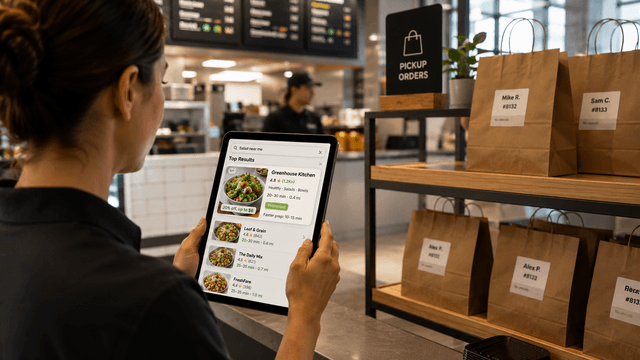
Delivery is still growing, and it is not going away. The National Restaurant Association in the United States says nearly 75% of restaurant traffic now happens off-premises, and the U.S. online food delivery market generated $52.7 billion in 2024 alone. That is good news for revenue. It is also exactly why operators can no longer afford fuzzy payout math.
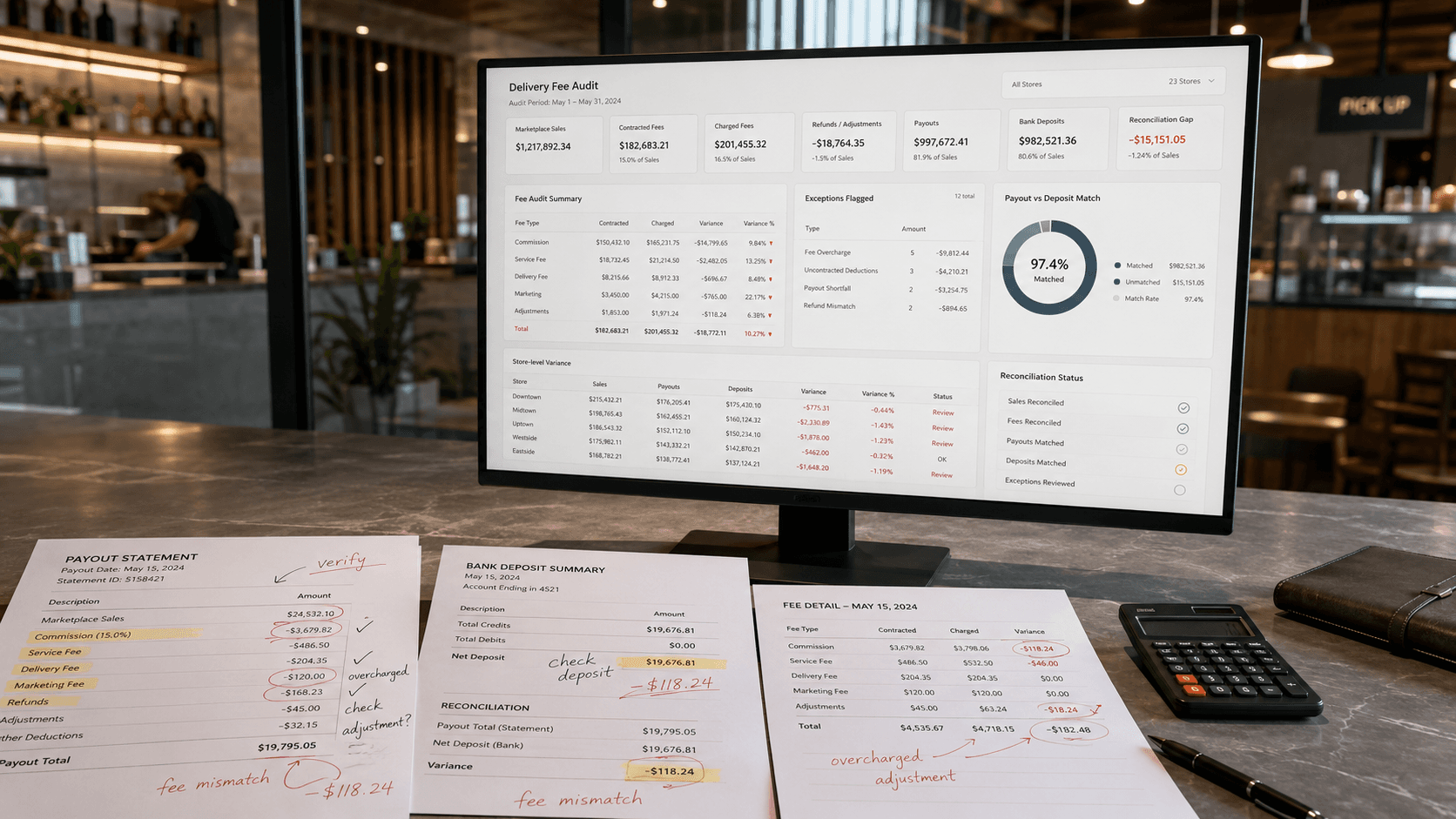
Third-party delivery fees are the full stack of deductions between marketplace sales and what actually lands in your bank account. That includes commission, pickup fees, delivery-service charges, processing, marketing, refunds, and post-order adjustments. If you only track the headline rate, you are probably understating your true delivery cost.
Most operators know the big headline. Fewer know the real stack.
On the current pricing pages, DoorDash lists 15%, 25%, and 30% delivery plans, with 6% pickup on qualified in-store pricing. UberEats shows marketplace tiers around 20%, 25%, and 30%, with pickup fees tied to validated in-store pricing. GrubHub pricing as marketing commission plus delivery starting at 10%. None of that is “wrong.” The problem is that most restaurants stop there, even though marketing spend, refunds, credits, adjustments, and reconciliation gaps are what usually push busy delivery nights into weak-margin nights.
If that sounds familiar, this post is for you.
What are third-party delivery fees, really?
Third-party delivery fees are not one fee. They are a fee stack.
At a minimum, most operators need to account for marketplace commission, pickup or delivery-service charges, card or processing costs where applicable, ad or promo spend, refunds, post-order adjustments, and the delta between expected payout and actual deposit. That last part is the one teams miss most, because it does not show up as one dramatic line item. It shows up as small leaks spread across locations, weeks, and platforms.
That is why a fee audit matters. You are not trying to prove every marketplace charge is bad. You are trying to answer a very practical question:
Did we get charged what we expected to get charged, and did the right amount of cash hit the bank?
If your team cannot answer that in under 10 minutes by store, you do not have a fee problem. You have a visibility problem.
Why the headline commission is only part of the story
The easiest mistake in delivery finance is treating the contract rate like the total cost.
It is not.
A service that looks like 20% to 25% on paper can end up materially higher after the full stack is included. Even mainstream operator guides and accounting advisories now warn that real delivery-platform cost often lands meaningfully above the advertised commission after marketing, refunds, extra charges, and other downstream deductions are counted.
There is also a timing problem. Discounts happen now. Some refunds, adjustments, and fee changes show up later. If your POS, statement export, and bank deposits are not tied together, you can overstate revenue, understate fee drag, and waste hours chasing the wrong explanation at month end.
That matters even more now because regulators are paying closer attention to delivery-fee transparency. In 2026, the FTC proposed a crackdown on hidden or misleading third-party delivery charges. Whether you think that changes operator economics or not, it tells you something important: fee complexity is no longer a niche complaint. It is a real operating issue.
Which fees should restaurants audit every month?
Start with the lines that actually move cash.
> First, confirm your contracted marketplace rate by channel. If a store should be on one delivery tier and is charged as if it is on another, that is a margin leak hiding in plain sight.
> Second, split pickup economics from delivery economics.
> Third, isolate any ad or promo spend so your team does not lump “visibility spend” into “platform fee.”
> Fourth, review settlement adjustments, credits, fee corrections, and post-order changes.
> Fifth, map statement payouts to real deposits. If the cash trail is weak, the fee discussion never gets settled.
For multi-unit brands, do this by store, not just by brand. Group averages hide the very stores that need attention.
A simple example shows why. If one location is overcharged by just 2 percentage points on a $100,000 monthly marketplace subtotal, that is a $2,000 leak. Across 20 locations, that is suddenly real money. And it is exactly the kind of leak most teams miss because each statement line looks “close enough.”
How do you run a third-party delivery fee audit?
Use this process every month.
1. Pull each marketplace’s pricing-plan terms and any negotiated addenda.
2. Export the statement, payout report, and bank deposits for the same period.
3. Separate commission, processing, delivery-service charges, promos, refunds, and adjustments into their own columns.
4. Calculate total fees over net sales by store and by marketplace.
5. Compare stores to each other, not just to the contract headline.
6. Tie every payout ID to a real deposit date and amount.
7. Escalate mismatches with evidence: store, date, payout ID, expected fee logic, actual fee logic, and dollar variance.
That is the basic audit. The better version is to repeat it the same way every month so you can spot drift, not just one-off issues.
The moment you standardize this workflow, a few things happen fast.
You stop arguing from memory.
You stop relying on one heroic finance person.
And you stop treating delivery fees like a mystery cost of doing business.
What does a healthy fee strategy look like by store?
A healthy delivery-fee strategy does not mean “lowest commission at all costs.”
It means each store has a clear answer to four questions:
- What is our true total fee burden by marketplace?
- Which charges are structural, and which ones are avoidable?
- Which stores are outside the expected band?
- What changes actually improve net payout instead of just top-line orders?
This is where weaker fee articles usually fall short. They tell you to raise prices, cut apps, or push direct ordering. Sometimes those are valid moves. But operators still need hard visibility before they change anything. A blanket markup can hurt conversion. A promo can raise sales while lowering payout quality. A cheaper plan can reduce discoverability enough to wipe out the savings.
The better move is to make each store’s delivery P&L visible first.
That means looking at subtotal, total fees and commissions, marketing spend, adjustments, refund pressure, and actual payout together. Not in five tabs. In one view.
Where does automation actually help?
This is the part operators care about: what should still be manual, and what should not?
Contract interpretation should stay human. Escalation judgment should stay human. Final sign-off should stay human.
But the repetitive parts should not stay manual if you are running at scale.
Voosh’s finance and reconciliation workflow connects POS, marketplaces, and bank data, auto-matches orders to deposits, surfaces differences, and exports clean entries to accounting. Its finance page also explicitly calls out marketplace charges mapping and commission auditing. That is exactly where automation belongs: order-to-deposit matching, variance visibility, and repeatable fee validation.
And this is not just theory. In one published case study, a six-location operator reconciled $313.27K in third-party delivery revenue and tracked $75.17K in deductions across nearly seven months. That is the kind of visibility finance teams need before they can decide whether the issue is pricing, promo discipline, statement drift, or plain old overcharging.
If the issue turns out not to be fees alone, the adjacent tools matter too. Voosh also publicly positions marketplace dispute automation for invalid charges and an ads and promotions dashboard that shows ROAS, cost per order, and payout lift. That matters because fee control is only half the story. The other half is avoiding spend that looks good in sales but bad in cash.
What should operators do next?
Do not wait for quarter-end to fix a monthly problem.
This week, pick one marketplace, one statement period, and one location group. Rebuild the fee stack from subtotal to deposit. If the math is clean, great. You just created a repeatable control. If it is not clean, even better. You found the leak before it compounded.
If you want a simple rule, use this one:
Track delivery fees like COGS, not like a weird platform tax.
That mindset shift is what separates “delivery grew” from “delivery actually paid.”
Off-premises demand is still strong, and customers are not suddenly walking away from convenience. The operators who win are the ones who stop guessing at payout quality and start managing it like an operating discipline.
If your team wants one place to see the path from order to payout to deposit, book a demo.
The goal is not another dashboard for the sake of it. The goal is faster answers, cleaner month-end closes, and fewer margin leaks hiding inside your delivery statements.