Master Multi-Unit Restaurant Delivery Operations
Summary Highlights
Centralize delivery operations across all locations with our multi-unit restaurant software. Streamline orders and menus to boost profits chain-wide.
Managing delivery for a single restaurant is hard – doing it for two, five, or dozens of locations is a whole new challenge. Multi-unit restaurant delivery operations mean coordinating orders, menus, and workflows across all your outlets on platforms like DoorDash, Uber Eats and Grubhub. It requires centralizing data so every location operates like a well-oiled machine. With unified analytics and automation, chain and franchise operators can standardize menus and pricing, centralize order management, and quickly spot trends across regions. These strategies not only cut costs but also drive revenue growth.
What Are Multi-Unit Restaurant Delivery Operations?
In a multi-unit setup, a restaurant brand has multiple physical locations (and possibly ghost kitchens or food courts) under one roof. Each location may receive its own batch of third-party orders – often through separate accounts or tablets – which can lead to data silos. Multi-unit delivery operations involve consolidating those separate streams: one platform to track all orders, fees, and reviews for every store. This lets operators compare performance, ensure consistency, and scale effectively. In short, it’s about treating your entire chain as a single delivery network rather than isolated shops.
Why Centralized Data Matters for Multi-Unit Restaurants.
When orders, customer info, and finances are scattered, nothing scales. Centralized data means each location uses the same POS integration and gets full visibility into key metrics. For example, tracking delivery-time trends or popular items across all branches lets managers refine operations (like adjusting staff or promotions) to boost efficiency. Studies show 73% of diners expect speedy delivery, so chains must identify slowdowns at any store quickly. A unified system ensures your marketing and menu changes apply everywhere, maintaining one brand experience. As Ventagenie reports, delivery apps now account for over 60% of orders in major markets – making this data gold for chains that collect and act on it.
Common Challenges in Multi-Unit Delivery Management.
Running multiple restaurants introduces unique pains. Each location may have different tech (varying POS or delivery integrations), causing confusion and extra work. For example, one store might use one tablet for DoorDash, another uses a phone app for Uber, making it nearly impossible to see aggregated sales. Disputes or missing orders can pile up in chaos if not tracked centrally. Even tracking promotions is tricky: a chain coupon or campaign needs to be coordinated so every location runs the same deal. Staffing issues (2 million industry jobs unfilled) only compound this: when a manager is stretched across several stores, they need automation to catch errors or untimely reviews. Moreover, manual menu updates at each point of sale can cause menu mismatches and oversights. These friction points cost money: the online delivery market is predicted to hit US$1.4 trillion by 2025, so failing to optimize multi-unit processes means leaving profit on the table.
Effective Strategies to Optimize Multi-Unit Delivery Operations.
Rather than juggling separate systems, successful multi-unit restaurants use a single platform for coordination. Key tactics include:
- Standardize menus and pricing: Keep item names, descriptions, and prices uniform on all apps. This avoids customer confusion and ensures a consistent brand.
- Use a unified order dashboard: A central dashboard collects every store’s orders in one place. Staff and managers can then see total sales, peak hours, and product breakdowns across the chain. This helps them reallocate resources and staff to busy locations in real time.
- Centralize dispute and fee management: When a customer dispute or an overcharge happens, a multi-unit platform auto-flags it no matter which branch it originated from, recovering revenue faster. For instance, Voosh’s Dispute Automation (a centralized, AI-driven tool) recovers lost sales with about an 80% win rate. This kind of automation frees up staff to focus on guests instead of paperwork.
- Automate reconciliation and reporting: Daily sales and deposit data from every location should be pushed into one report. Voosh’s Finance & Reconciliation feature, for example, automatically pulls invoices and order summaries from all channels into one view, eliminating manual accounting.
- Coordinate promotions and marketing: Launch chain-wide promotions from one interface. A unified system lets you set up a time-limited offer or coupon that applies to all stores’ third-party menus without logging into each account. Plus, aggregated data shows which markets or locations respond best, so you can fine-tune future offers.
- Leverage real-time alerts: Use automation for store status. If one location’s delivery app goes offline or runs out of items, a unified tool can immediately shift orders to other branches, preventing downtime losses. Voosh’s Downtime Controller, for example, notifies operators and pauses menu items on an app during outages, maximizing uptime across all locations.
Leveraging Unified Analytics & Automation at Scale.
With all data in one place, multi-unit operators gain actionable insights. For example, by comparing the average order value (AOV) or item mix between stores, managers can promote high-margin items chain-wide or identify underperforming locations. Industry data reveals delivery apps often generate 42% more revenue for restaurants within the first year of adoption. Chains can tap into this by analyzing which menu bundles or upsells worked best at top-performing locations, and then replicating them chain-wide. AI tools also play a role: 95% of restaurants now use AI-driven management for tasks like menu optimization and inventory. Multi-unit chains benefit by applying AI models across all stores – for instance, predictive staffing based on forecasted delivery volume or optimizing delivery zones for regional warehouses. By standardizing this tech across locations, chains avoid “siloed data” chaos and achieve consistent operations, exactly as experts recommend.
Choosing the Right Tools for Multi-Unit Delivery Management.
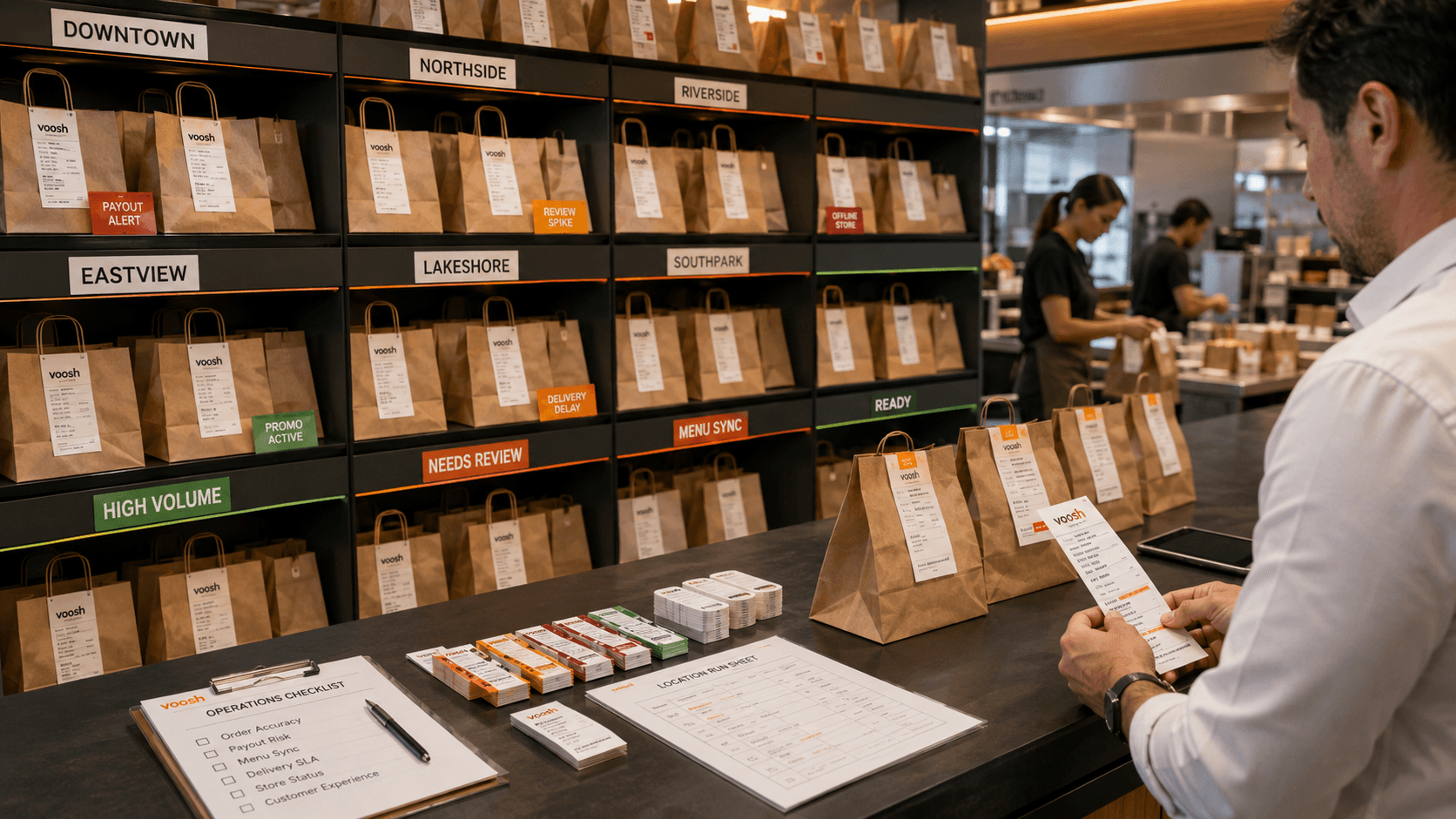
Not all platforms support scale. When evaluating solutions, look for: full integrations (POS, accounting, marketplaces), data standardization, and automation. For example, Voosh consolidates third-party orders and reviews for multiple locations into one dashboard. Its unified inbox means a chain manager can reply to reviews or address disputes at scale. Meanwhile, competitors like KitchenHub also promote a “single source of truth” model for menus and orders. Key features to demand include a single dashboard for all apps, real-time performance reporting, and store-level alerts. A good tool will let you drill down by city, region, or store, and also roll up overall stats. In practice, chains using unified platforms report smoother opening of new locations and quicker growth – because once data flows seamlessly, scaling is just about applying proven success to a new store.
Conclusion
Multi-unit restaurants who centralize their delivery data and operations gain control and visibility, turning a complex chain into one coherent business. By standardizing processes, automating disputes and reports, and using unified analytics, chains can increase efficiency and profits. Adopting a modern delivery intelligence platform like Voosh equips multi-unit operators with exactly these tools – from dispute recovery to real-time dashboards – so they never miss a beat across any location. Ready to take control of your chain’s delivery performance? Book a demo today and see how Voosh can streamline your multi-location restaurant operations.