Delivery App Promotions: How to Know If Yours Are Actually Working
Summary Highlights
Order volume going up doesn't mean your promotion is working. Learn how to calculate delivery app promotion ROI, spot discount leaks, and figure out which promos are actually generating new revenue — and which are just discounting orders you already had.
Delivery App Promotions: How to Know If Yours Are Actually Working
Running promotions on DoorDash, Uber Eats, and Grubhub is the default play for restaurant operators trying to grow delivery volume. Spend a few weeks setting up a percentage-off deal, watch order counts go up, and call it a win.
Except the order count going up isn't the same as the promotion working. A promotion that lifts your gross revenue while costing you more than it generates - through discounts, commission stacking, and incremental fees - isn't a growth tool. It's a margin leak wearing a good metric as a disguise.
This guide breaks down what it actually means for a delivery promotion to be working, how to calculate whether yours are, and what to do when the numbers don't add up.
Quick definition: A delivery app promotion is any discount mechanism offered through a third-party platform - percentage off, buy-one-get-one, free item, or subsidized delivery - that incentivizes customers to order. Whether it works depends not on order volume alone, but on whether the incremental revenue generated exceeds the total cost of running it, including promotional discount and any additional platform fees.
What 'Working' Actually Means for a Delivery Promotion
Incremental Orders vs. Discounted Existing Demand
The central question in promotion measurement is one most operators never ask: would those orders have happened anyway?
If your Tuesday promotion generates 40 orders but your average Tuesday without a promotion produces 35 orders, the promotion generated 5 incremental orders. The other 35 represent existing demand that simply got discounted - customers who would have paid full price.
Running a promotion that mostly discounts existing demand isn't zero-value, but it's expensive. You are paying the platform's promotional fees and absorbing the discount on revenue that was already yours. The ROI on that spend is deeply negative, and you won't catch it by looking at order volume.
The Three Metrics That Determine Whether a Promotion Is Profitable
- Incremental order count - orders above your non-promotion baseline for the same period.
- Net revenue per order - average order value minus the discount applied, before commission.
- Promotion cost - the actual out-of-pocket expense: your discount contribution + any platform promotional fees charged on top of standard commission.
If incremental orders × net revenue per order > total promotion cost, the promotion is generating a positive return. If not, you are subsidizing your platform.
The Two Biggest Promotion Measurement Mistakes
Measuring Gross Revenue Instead of Net Revenue
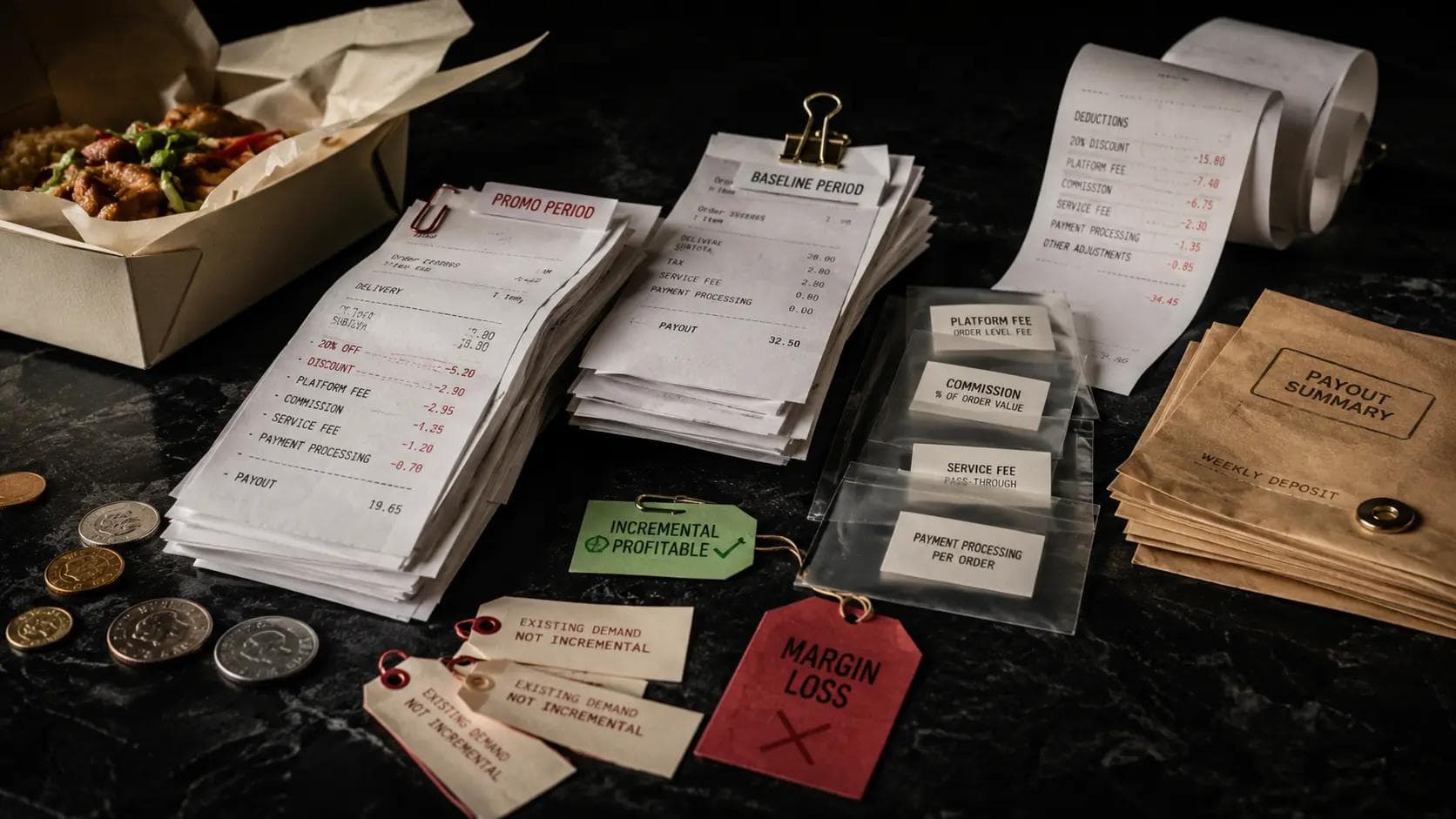
The most common error: operators look at gross sales during a promotion period and see a number larger than the previous week. What they don't see is that the discount eroded their average order value while the platform's promotional fees - which sit on top of standard commission - further compressed net payout.
On a typical 30%-off promotion, a $40 order becomes a $28 order from a revenue standpoint. Then standard commission comes off that. Then in some cases a promotional service fee. The actual payout per order can drop to a point where you needed 60% more orders just to stay flat. Most operators don't run that math before launching.
Understanding your true margin on delivery before running promotions is foundational. See our breakdown of restaurant profit margin on delivery apps for the baseline.
Running Always-On Promotions With No Baseline
The second mistake: running a promotion continuously without a control period. If your promotion has been live for eight weeks without a break, you have no baseline to compare against. You cannot measure incrementality because you have never seen what demand looks like without the discount.
This matters more than operators realize. Platforms often build customer expectations around your discount. When you pause it, order volume dips - not because the promotion was working, but because the platform had started surfacing you to discount-seeking customers who will move on when the deal ends. That dip feels like the promotion was valuable. It wasn't - you were renting demand.
Voosh data (2025): Restaurants that run promotions continuously for 90+ days without a control period see an average 18% order volume drop in the first two weeks after pausing - regardless of whether the promotion was profitable. This dependency effect makes it harder to ever accurately measure what the promotion was worth.
How to Calculate Delivery Promotion ROI
The Formula
Promotion ROI = [(Incremental Orders × Net Revenue Per Order) − Total Promotion Cost] ÷ Total Promotion Cost × 100, Example: 20 incremental orders × $22 net revenue = $440 incremental net revenue. Total promotion cost (discounts + fees) = $310. ROI = ($440 − $310) ÷ $310 × 100 = +42%.
A positive ROI means the promotion generated more revenue than it cost. A negative ROI means you paid to discount orders you would have received anyway, or received fewer incremental orders than the promotion cost to run.
Accounting for Commission Stacking
Most operators know their standard commission rate, typically 15-30% depending on platform and plan. What many miss is that delivery app promotions often carry additional promotional fees on top of standard commission. The specific fee structure varies by platform and promotion type, but the effect is consistent: your effective commission rate rises when you run a promotion.
This matters for the ROI formula. If your standard commission is 20% and your effective promotional commission is 28%, every incremental order you generate is generating less net revenue than your baseline assumptions suggest. Build the actual promotional payout rate into your calculation, not your standard rate.
For a deeper look at commission structures and how to audit them, see our guide to food delivery KPIs every restaurant should track.
Which Promotion Types Tend to Work - and When
Not all promotion structures carry the same risk profile. Here's how the four main types compare:
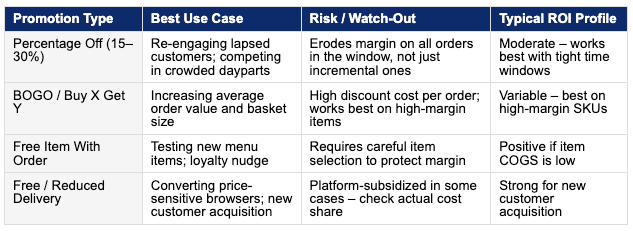
There is no universally best promotion type. The right choice depends on your margin profile, your current customer mix, and what outcome you are actually trying to drive - new customers, repeat orders, or volume lift in a slow daypart.
Reading Promotion Data Across Platforms
Where to Find It
- DoorDash Merchant Portal: Navigate to Marketing → Promotions. You'll see impressions, orders generated, and average order value for each promotion. Look at orders generated against your non-promotion baseline for the same day/time window.
- Uber Eats Manager: Under Marketing → Promotions, Uber Eats shows orders attributed to promotions and an estimated uplift figure. Treat the platform's own uplift figure as directional only - validate it against your own baseline comparison.
- Grubhub for Restaurants: Promotions data is accessible under the Promotions section in your dashboard. Compare your promotion periods against equivalent non-promotion windows by day of week and meal period.
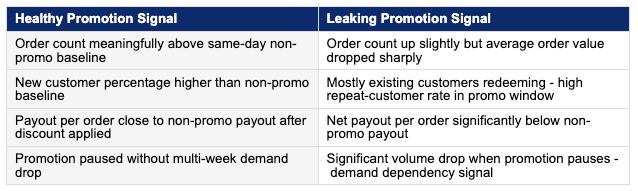
What a Healthy Promotion Looks Like vs. a Leaking One
Multi-Location Operators: Why Blanket Promotions Cost More Than You Think
This is the one that consistently surprises growing restaurant groups. Running a 20%-off promotion across 25 locations feels like a smart way to move the needle at scale. What it actually does is apply a uniform discount to locations with completely different margin profiles, demand patterns, and competitive contexts.
Location A in downtown Chicago might have strong organic delivery demand and low price sensitivity - a blanket discount there generates almost no incremental orders, it just erodes margin. Location B in a suburban market might be fighting for visibility against several similar concepts - a targeted promotion there could generate meaningful uplift.
When you apply one promotion across both, the ROI of Location A subsidizes the test at Location B, and the blended result looks acceptable. You never find out that half your promotional spend is working and half is waste.
For context on managing performance across locations, see our guide to multi-unit delivery operations management.
How Better Promotion Visibility Changes the Equation
The core problem with promotion measurement at scale isn't that the math is hard - it's that the data is fragmented. Your DoorDash promotion data lives in DoorDash's portal. Your Uber Eats numbers are in a different dashboard. Running a promotion across both platforms simultaneously while trying to maintain a baseline from the same period last week requires either a lot of manual spreadsheet work or a tool that does the aggregation for you.
Voosh's Promotions Manager pulls promotion performance data across DoorDash, Uber Eats, and Grubhub into a single view, so you can compare promo performance by platform, by location, and by time window without logging into three separate dashboards. For multi-unit operators, the ability to see which locations are generating positive ROI on a promotion and which are bleeding margin means you can make informed decisions about where to keep running and where to pause - instead of applying blanket logic and hoping the aggregate number looks good.
See how targeted promotions can be structured for better ROI outcomes in our guide to personalized delivery promotions.
Voosh data (2025): Operators who measure promotion performance at the location level - rather than as a blended portfolio average - identify an average of 30% of promotion spend generating negative ROI within the first 60 days. Reallocating that spend to higher-performing locations or promotion types produces measurable net revenue improvement without increasing total promotional budget.
The Promotion Measurement Checklist
- Before launching any promotion, record your baseline: average daily orders and average order value for the same day of week and meal period over the prior four weeks.
- Set a defined run window. Open-ended promotions make measurement impossible.
- After the promotion runs, compare total orders and net payout per order against your baseline - not just against the prior period.
- Calculate incremental orders (total orders minus baseline) and multiply by net payout per order after discount.
- Compare that figure against your actual promotion cost (discount contribution + promotional fees). If it's negative, pause and recalibrate.
- For multi-location operators: run this analysis per location, not as a blended average.
- Build in a control period every 8-12 weeks, a promotion-free window, to reset your baseline and avoid demand dependency.
Conclusion
Delivery app promotions are a legitimate growth tool when they are measured, targeted, and managed with actual cost data. The problem is that most operators use order volume as a proxy for success - and order volume will almost always go up when you run a discount. What it won't tell you is whether you paid more to generate those orders than they were worth.
The operators building durable delivery businesses aren't running the most promotions. They're running the ones that actually generate a return, and pausing or restructuring the ones that don't. That discipline requires data - across platforms, across locations, and over time.
Want to see your promotion performance across all platforms in one place?
Book a demo with us → voosh