Food Delivery KPIs: The Key Metrics Every Restaurant Should Track
Summary Highlights
Food delivery KPIs measure how efficiently, accurately, and profitably a restaurant handles off-premise orders. Tracking these metrics helps improve marketplace rankings, customer satisfaction, and revenue. As delivery becomes essential for most consumers, operators must use a data-driven approach. By monitoring KPIs like order speed, accuracy, and cancellations, restaurants can identify bottlenecks, reduce errors, and optimize performance. Platforms like Voosh simplify this by unifying data from POS systems and third-party apps into one real-time dashboard.
By Bilal - October 30, 2025
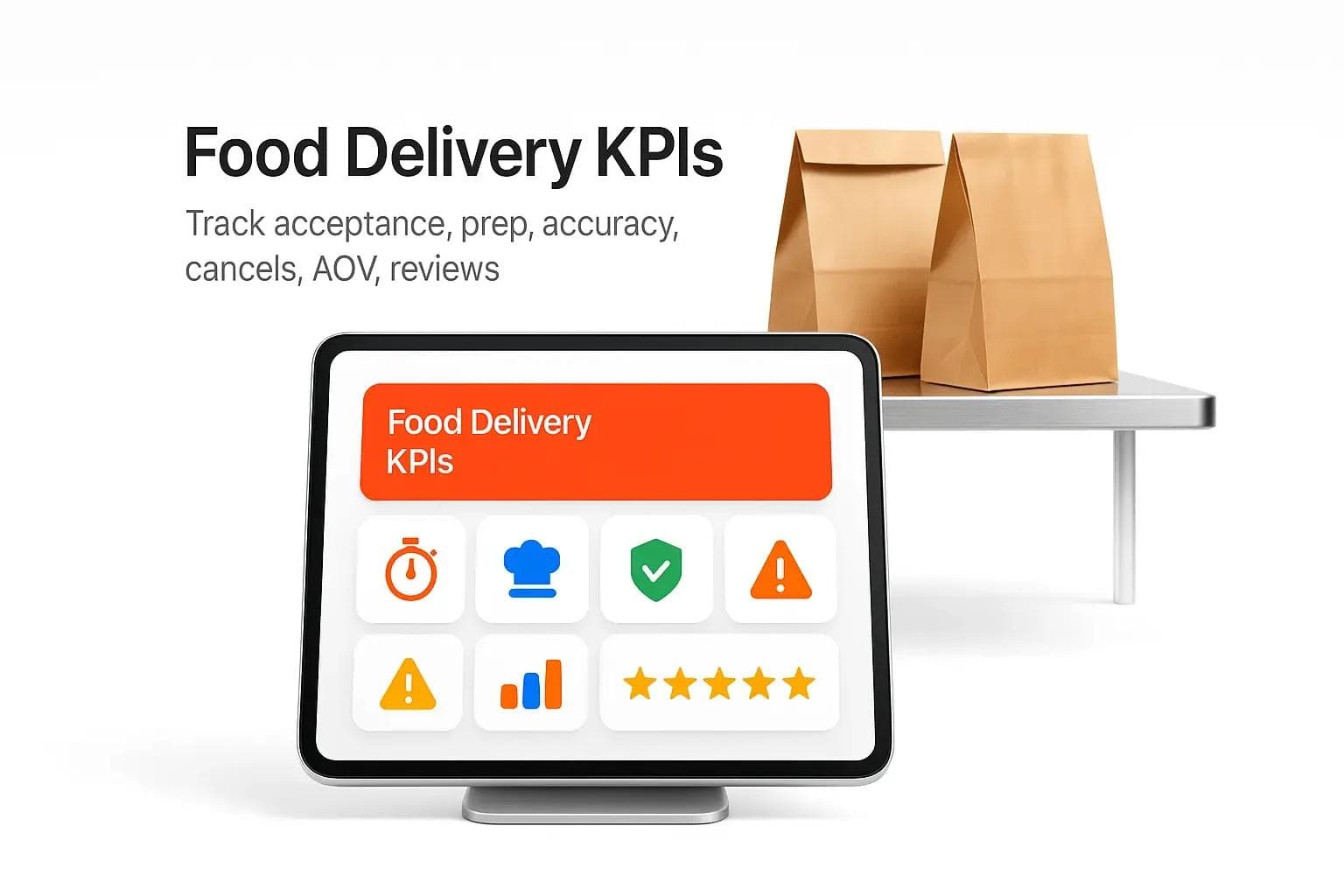
Food delivery KPIs are the quantitative measures that track the efficiency, accuracy and profitability of your off‑premise operations. They cover everything from how quickly you accept an order to whether the guest receives the correct dish on time. When you understand and optimize these metrics, you improve your ranking on marketplaces, delight guests and grow revenue.
Today, delivery isn’t a side gig; it’s core to how guests eat. More than half of US consumers now consider takeout and delivery an essential part of their lifestyle, and 56 % of Canadians and 46 % of Americans prefer ordering via third-party apps . To stay competitive, independent and multi‑unit operators need a data‑driven approach. This guide breaks down the most important KPIs, explains why they matter and shows how to act on them using a unified dashboard like Voosh.
Why KPIs Matter for Delivery Operations
The shift to digital ordering has intensified competition. Your listing competes with dozens of similar restaurants on DoorDash, Uber Eats and Grubhub. These platforms rank merchants based on service speed, accuracy and customer satisfaction. Tracking KPIs lets you:
- Benchmark performance against industry standards and your own historical data.
- Identify bottlenecks in kitchen prep, order handoff or courier pickup.
- Spot revenue leaks such as high cancellation rates, unclaimed refunds or under-priced orders.
- Improve guest experience by reducing avoidable waits, errors and delays.
- Justify investments in staff, equipment or technology using hard data.
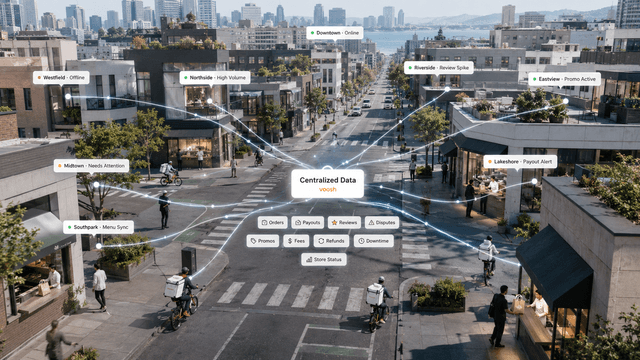
Voosh consolidates metrics from every third‑party app and your POS so you’re not jumping between multiple dashboards. In an operator's account, the Operations Quality dashboard surfaces real‑time KPIs like error charges, unfulfilled orders and avoidable wait times across channels.
Core Food-Delivery KPIs
This section covers the essential metrics you should monitor regularly. Each includes a definition, why it matters, how to calculate it and actionable tips to improve.
1. Order Acceptance Time
What it is: The time between when a customer places an order and when your team accepts it.
Why it matters: Longer acceptance times delay the entire process and hurt your ranking on delivery apps. Cuboh notes that slow acceptance can lead to cancellations and lower visibility .
How to calculate: Most apps provide this data; calculate the average acceptance time for all orders over a specific period.
Improvement tips:
- Assign staff or automate acceptance using integrations so no order sits idle.
- Consolidate tablets so you’re not toggling between devices.
- Provide clear SOPs for busy shifts, ensuring someone monitors incoming orders at all times.
2. Order Preparation Time
What it is: The time it takes to prepare an order once it’s accepted until it’s ready for pickup. Intelivita breaks this down into order placement, kitchen processing and dispatch time .
Why it matters: Guests expect quick service. According to a Statista study referenced by Intelivita, 38 % of consumers want their food delivered within 21–30 minutes . If your prep time pushes total delivery beyond that window, customers will look elsewhere.
How to calculate: Measure the time between acceptance and when the order is handed to the courier. Average this across orders.
Improvement tips:
- Streamline kitchen workflow: prep popular items in batches and keep mise en place stocked.
- Use a kitchen display system integrated with your delivery apps to eliminate manual ticket entry.
- Monitor equipment maintenance; slow cook times often trace back to neglected appliances.
3. Order Accuracy Rate
What it is: The percentage of orders delivered without missing or incorrect items.
Why it matters: Incorrect orders destroy trust and lead to refunds, bad reviews and churn. Intouch Insight’s study found that drivers handling multiple deliveries experienced temperature declines and lower order accuracy .
How to calculate: (Number of correct orders ÷ Total orders) x 100.
Improvement tips:
- Implement Voosh's auto dispute resolution to verify items before sealing the bag.
- Label each bag clearly with customer name and contents to prevent mix-ups.
- Voosh integrates third-party orders directly into your POS to reduce manual entry mistakes.
4. Unfulfilled Order Rate (Cancellation Rate)
What it is: The percentage of orders you cancel or cannot fulfill after acceptance.
Why it matters: High cancellation rates damage your reliability score on apps and trigger commission penalties. In the Voosh dashboard for a restaurant chain in New York, unfulfilled orders were 0.72 % of total orders, a metric flagged as needing improvement.
How to calculate: (Number of cancelled/unfulfilled orders ÷ Total orders) x 100.
Improvement tips:
- Keep menu items up to date to avoid unavailable items being ordered.
- Monitor stock levels and sync your inventory with delivery menus.
- Cross-train staff so short staffing doesn't force cancellations.
5. Average Order Value (AOV) & Revenue per Order
What they are: AOV is the average amount a customer spends per order. Revenue per order measures profit after fees and costs.
Why they matters: High order volume is pointless if margins are razor thin. Cuboh suggests using upsells and bundles to boost AOV .
How to calculate: AOV = Total online revenue ÷ Total orders. Revenue per order = (Total revenue – total costs – commissions – refunds) ÷ Total orders.
Improvement tips:
- Offer combos and add‑ons within third‑party menus.
- Price high‑margin items strategically and adjust packaging fees to cover costs.
- Use Voosh to identify best‑selling items and promote them in your storefronts.
6. Customer Satisfaction & Repeat Order Rate
What they are: Customer satisfaction is measured through ratings and reviews; repeat order rate tracks how often the same customer orders again.
Why they matters: According to DoorDash's 2025 report, 47 % of US consumers place repeat restaurant orders at least weekly . High satisfaction fosters loyalty, reduces acquisition costs and improves marketplace ranking.
How to calculate:
- Satisfaction: Use Voosh to track average star rating across platforms and the ratio of positive vs. negative reviews.
- Repeat rate: (Number of repeat orders ÷ Total unique customers) × 100.
Improvement tips:
- Respond to reviews promptly and professionally. Voosh’s Reviews & Reputation module consolidates ratings and makes it easy to reply (with or without automation).
- Use targeted promotions to bring back customers—e.g., offer a discount code after the second order. Need help? 👉 voosh.ai/promotion-manager
- Consistency is key; maintain quality control to avoid variability in food and service.
7. Cost & Profitability Metrics
What they are: Commission fees, packaging costs, marketing spend and net margins for delivery channels.
Why they matters: Without understanding your cost structure, you could lose money on each delivery. DoorDash’s consumer study shows that 82 % of customers expect specials or discounts , meaning you must balance promotions with profitability.
How to calculate: Break down each order into revenue, third‑party commission, error charges, marketing spend, packaging cost, food cost and labor. Subtract costs from revenue to determine net profit per order.
Improvement tips:
- Audit commission fees and reimbursements; Voosh’s Commission Auditor module automatically scans for platform errors.
- Bundle free delivery with upsells rather than discounting food.
- Test promotions on a small scale and measure ROI before scaling up. Need help? 👉 voosh.ai/promotion-manager
How to Collect and Analyze Your KPI Data
To make data actionable, you need a single source of truth. Pulling reports from multiple apps and your POS is time‑consuming and increases error risk. A unified platform like Voosh aggregates data from DoorDash, Uber Eats, Grubhub and others, and reconciles it with your POS, Accounting software and bank records. The Operations Quality module displays core KPIs—error charges, unfulfilled orders, avoidable wait times—alongside charts showing issue breakdowns.
Additional benefits of using a centralized dashboard:
- Automated dispute management: Voosh’s dispute manager scans for order errors, pulls CCTV evidence and files disputes automatically.
- Financial reconciliation: Compare third‑party estimated payouts vs. actual deposits, POS sales vs. bank deposits and even credit‑card vs. POS vs. bank reconciliation.
- Review consolidation: Monitor ratings from all platforms in one place and benchmark sentiment over time + auto reply.
Strategies to Improve Your KPIs
Here are actionable steps to turn data into performance improvements:
- Set baselines and goals. Before optimizing, know your current numbers. Set SMART goals—e.g., reduce average acceptance time by 30 seconds within two weeks.
- Prioritize high-impact metrics. Address KPIs that directly affect rankings first (acceptance time, prep time, accuracy), then work on profitability metrics.
- Streamline workflows. Consolidate tablets, integrate order management with your POS and automate acceptance to minimize delays.
- Train and incentivize staff. Use KPI dashboards during team huddles. Celebrate improvements and provide coaching where metrics lag.
- Use technology to reduce errors. Implement integrated kitchen displays, automated refund/dispute using Voosh and downtime monitors.
- Test and iterate promotions. Monitor how discounts or new menu items affect AOV and repeat order rates. Adjust quickly if margins suffer.
- Analyze cancellations. Investigate why orders are unfulfilled—stock outs, driver no-shows, staff errors—and address root causes.
Real-World Example: How Voosh Surfaces KPI Insights
In Voosh's Operations Quality dashboard, a client data illustrates the power of a unified view. For a multi-location brand, the platform tracks:
- Error charges of $22,966.65 over a period, highlighting a 10 % reduction compared with the previous period.
- Unfulfilled order rate of 0.72 % across 45,205 orders; it flags the metric as needing attention.
- Average DoorDash avoidable wait of 3 minutes 31 seconds—longer than the 3-minute goal.
- Issue breakdown charts that visualize the causes of canceled or erroneous orders (ingredient error, missing items, wrong order).
By surfacing these insights, operators can drill into specific locations or channels and take targeted action. For instance, a surge in “missing item error” suggests training pack‑out staff, while long avoidable waits may require adjusting prep workflows or enabling auto‑start timers.
Conclusion: Measure What Matters
Delivery isn’t slowing down—more consumers consider it part of their lifestyle, and demand spans meals, snacks and drinks . But success depends on consistency and efficiency. By tracking KPIs like order acceptance time, prep time, accuracy, cancellation rate, AOV, satisfaction and profitability, you gain the insights needed to make smart decisions.
Voosh consolidates these metrics across every third‑party platform, automates dispute resolution and financial reconciliation, and equips you with dashboards that make data actionable. Ready to see your own delivery KPIs in one place? Book a demo and let’s turn numbers into growth.
FAQ's
What is a KPI in food delivery?
A KPI (Key Performance Indicator) in food delivery is a measurable data point—such as order acceptance time, preparation time, disputed order or order accuracy—that reflects how efficiently your delivery operation is running. Tracking KPIs helps restaurants identify bottlenecks, benchmark performance and improve customer satisfaction.
How do I calculate average order value for my restaurant’s delivery service?
Divide your total delivery revenue by the number of delivery orders during the same period. For example, if you generate $5,000 from 200 orders, your average order value is $25. Monitoring AOV helps you optimize pricing and upsell strategies.
Why does my order acceptance time affect my ranking on delivery apps?
Third‑party platforms prioritize restaurants that accept orders quickly because fast acceptance leads to faster delivery times and happier customers. Long acceptance times can lower your ranking and reduce visibility, which means fewer orders .
How can I improve delivery order accuracy?
Use integrated kitchen displays to eliminate manual ticket entry, establish a double‑check station before sealing orders, and label each bag clearly. Tracking the order accuracy rate helps you see if these improvements are working over time.
Is it worth investing in a unified delivery dashboard like Voosh?
If you operate across multiple third‑party apps or have multiple locations, a unified dashboard saves time, reduces manual errors and reveals insights you would otherwise miss. Voosh’s platform not only consolidates data but also automates dispute filing, financial reconciliation, customer review reply, ads/promotions and downtime monitoring.