Review Response Templates for Delivery Apps
Summary Highlights
The article explains the importance of responding to delivery-app reviews to protect and improve a restaurant's online reputation, as public replies influence future customer decisions. It offers practical, copy-paste templates tailored to different star ratings and common delivery issues like missing items, wrong orders, or cold food. It also outlines a simple six-step review workflow and strategies for multi-location consistency, emphasizing fast, professional, and solution-focused responses.
If you sell on delivery apps, you are getting judged in public every day. Not just on food quality, but on accuracy, packaging, and whether the order shows up hot. The tough part is that the feedback lands in different places, at different times, and it stacks up fast.
This post gives you copy-paste templates you can use today, plus a simple workflow you can run as a one-shop operator or across 50 locations.
Review response templates are pre-written reply frameworks you can personalize in seconds. For delivery apps, the best templates do three things: acknowledge the specific issue, invite the guest to a private resolution path, and capture the root cause (so the same complaint stops showing up).
Why do delivery app review replies matter for restaurant sales?
On most marketplaces, your star rating is part of the shopping experience. Guests compare you to the restaurant next door with the same cuisine, the same price point, and a photo that looks just as good. If your rating slips, you do not just lose ego points. You lose clicks.
BrightLocal 🇺🇦's Consumer Review Survey shows how much written feedback still shapes buyer confidence. In 2024, 69% of consumers said they would feel positive about using a business if its written reviews describe positive experiences.
Also, people are not reading in one place anymore. In BrightLocal 🇺🇦's 2025 survey, 74% of consumers said they use two or more websites when reading reviews before deciding to use a local business.
Translation for delivery: every review reply is public, searchable, and re-usable. It is one of the few places you can speak directly to a future customer while they are deciding.
Google's own guidance on review replies is a good north star even if the review lives on a marketplace: be professional, keep it short and simple, and respond when you have something useful to add.
How can you respond to delivery app reviews in 6 steps?
Here is the playbook we recommend because it is fast enough to execute daily, but structured enough to scale.
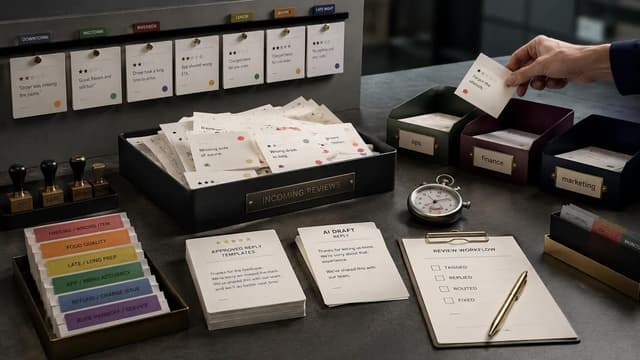
- Triage in 30 seconds. Tag it: food quality, accuracy, packaging, timing, service, or “not enough detail.”
- Start with a real thank-you. Even on a 1-star, thank them for taking the time.
- Own what you control. Apologize for the experience. Do not blame a driver or the platform.
- Ask for one missing detail. Order date, location, or the item that was missing.
- Move it offline. Provide a direct path to support so you can look up the order and make it right.
- Log the fix. Route the issue to ops (packaging change, expo checklist, menu photo update) so it stops repeating.
If you do nothing else, do steps 1, 3, and 5. That is how you protect your rating without writing a novel.
Copy-paste review response templates by star rating
Below are templates built for delivery scenarios. They are short on purpose. Your goal is to sound human, not “corporate.” Swap anything in brackets.
5-star delivery review response template (positive)
- Template A: Thanks for the 5-star review, [Name]. We are glad you loved the [dish]. If you order again, try it with [popular add-on]. We appreciate you choosing us on delivery.
- Template B (multi-location safe): Love hearing this, [Name]. Thanks for ordering from our [Location] team. We will share your note with the kitchen. Hope we can earn your next order soon.
4-star delivery review response template (mostly positive, one gap)
Thanks for the kind words, [Name], and for calling out [what they liked]. We also hear you on [what went wrong]. We are tightening up that part so your next order is a full 5 stars. If you are open to it, share the order date and we will take a closer look.
3-star delivery review response template (mixed)
Thanks for the feedback, [Name]. It sounds like we nailed [positive], but missed on [issue]. That is not the experience we want you to have. If you send us the order date and the item(s) involved, we will review what happened and make it right.
1-star and 2-star delivery review response templates (the ones that hurt)
These should be handled with calm, specific language. Your future customers are reading, even if the original reviewer never replies.
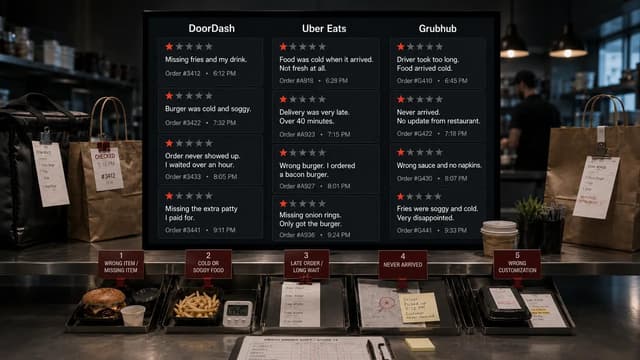
- Missing items:
Thanks for letting us know, [Name]. I am sorry your order was missing [item]. We use a packing checklist, but we clearly missed a step here. If you message us with the order date and name on the order, we will look it up and help with a replacement or credit. - Wrong order:
I am sorry we sent the wrong item, [Name]. That is frustrating, especially on delivery. Please reach out with the order details and we will sort this out quickly. We are also reviewing our expo handoff process to prevent repeat mix-ups. - Food arrived cold or soggy:
Thanks for the note, [Name]. I am sorry your order did not arrive in the condition we aim for. Packaging and timing both matter on delivery, and we are making adjustments so food holds better. If you share your order details, we will follow up and make it right. - Late delivery:
I am sorry the timing missed the mark, [Name]. We know delivery delays ruin the experience. Please send the order date and we will review what we can control on our side (prep timing and handoff) and help with a make-good. - Packaging spill or mess:
Thanks for flagging this, [Name]. I am sorry your order arrived messy. That is on us to package for the real world. We are updating our packaging standards for [sauces / soups / bowls] and would like to make this right. Please contact us with the order details. - Price or portion complaints:
I appreciate the honesty, [Name]. We work hard to price fairly while using quality ingredients, but we understand value matters. If you are open to sharing what felt off, we will review it with the team. We would also love a chance to earn back your trust on a future order. - Template for a 1-star review with no comment:
Thanks for the feedback. I am sorry we missed the mark. If you can share your order date and what went wrong, we will look into it and make it right. You can reach us at [support email/phone].
How do you respond when the complaint is really about delivery, not your food?
This is where many restaurants slip. Some replies throw the driver under the bus. Others accept blame for something they do not control. Both backfire.
A better approach is:
- Acknowledge the experience without assigning blame.
- Focus on what you can control (prep timing, packaging, accurate handoff).
- Offer a clear next step to fix it.
Example phrasing that works: “I’m sorry the order did not arrive as expected. We’re reviewing our prep and handoff timing, and we’d like to help resolve this. Please contact us with the order details.”
That line protects your brand and keeps you out of finger-pointing.
How can multi-unit teams keep review replies consistent across locations?
When you have more than a few stores, review replies break down in predictable ways:
- A few locations reply fast. Others go dark.
- Tone varies by manager. The brand voice drifts.
- Operational issues repeat because feedback never makes it to the right person.
The fix is not “write better replies.” It is a workflow.
Here is a simple model that works for U.S. and Canadian multi-unit teams:
A scalable review-reply workflow (roles + SLA)
Brand team owns templates. They set the voice, guardrails, and what you will offer for make-goods.
- Store leaders personalize. They add one detail and confirm what happened locally.
- SLA: 24 hours for 1-2 stars, 48 hours for 3 stars, and a lightweight template for 4-5 stars.
- Ops loop: every negative review gets tagged to a category and routed weekly.
This is exactly why Voosh's Reviews & Reputation Automation is built around an AI-assisted and template-driven system tuned to star rating and sentiment, with brand voice guardrails and a central inbox across channels.
How do you scale replies without sounding like a robot?
Templates are only half the answer. The other half is consistency.
Voosh's review module supports brand-safe auto replies with presets or manual responses, and it can include customer offers or discounts in replies when you choose to.
In practice, that means you can:
- Auto-reply to simple 5-star and “quick praise” reviews.
- Route anything negative to a human with the right context.
- Keep the tone consistent across every store.
Mini example (what this looks like day to day): A 12-location burger brand gets 25 to 40 reviews per week across delivery apps and search. They use three approved templates per star band, and managers only personalize one line. The central team checks a weekly report for “top issue types” (missing items, cold food) and fixes the root cause. The result is less time spent typing, and fewer repeat complaints.
Voosh data 2025 shows how big this can get at scale: over 1,000,000 reviews answered across marketplaces, with 10,000,000+ orders monitored for review triggers and QA, and 250K+ review replies that included discount coupons.
What should you track after you start replying?
If you want review replies to drive real outcomes, track a few metrics like you would any other operational process:
- Response rate: Are you replying to the reviews that matter (especially negative)?
- Time to first response: Same day is the target for low ratings.
- Average rating by channel and location: Look for drift.
- Sentiment trend: Is “missing items” decreasing week over week?
- Top recurring issues: Packaging, accuracy, timing, or food quality.
Voosh includes reputation analytics like sentiment trends, average ratings, and performance by location, plus configurable alerts and downloadable reports (CSV/PDF) to keep teams accountable.
A quick checklist for brand-safe replies
Before you hit send (or turn on auto replies), sanity-check these five items:
- Does the reply thank them and acknowledge the specific issue?
- Does it avoid blaming a driver or a platform?
- Does it invite a private follow-up path (email/phone)?
- Does it avoid asking them to edit or remove the review?
- Does it log a category so ops can fix the root cause?
If you can say “yes” to all five, you are good.
Wrap-up: reply faster, protect your rating, and learn from every complaint
Most restaurants do not need more reviews. They need a better system for responding to the reviews they already get.
Start with the templates above, then tighten the workflow so every location replies on time, in the same voice, with the same standards.
If you want a centralized inbox across delivery apps and search, AI-assisted replies tuned to rating and sentiment, and reputation analytics by location, book a Voosh demo.
FAQ
How do you respond to a 1-star review with no comment?
Use a short template that shows accountability and asks for the missing detail: “I’m sorry we missed the mark. If you share your order date and what went wrong, we’ll look into it and make it right.”
Is it okay to include a discount code in a review reply? It can be, as long as it is framed as a make-good for a real issue, not a reward for changing a rating. Keep it consistent, and follow each platform’s rules. Voosh supports including offers or discounts in replies when you choose to.
How fast should you reply to negative reviews on delivery apps?
Aim for within 24 hours for 1-2 star reviews. The faster you respond, the more you signal that you take service recovery seriously.
What is the biggest mistake restaurants make when replying to delivery reviews?
Blaming someone else. Even when the issue is delivery timing, future customers want to see that you take ownership of what you control and that you will help resolve the problem.