Restaurant Review Management Software for Delivery Brands
Summary Highlights
Restaurant review management software for delivery brands. Unify Google, Yelp, DoorDash, Uber Eats, and Grubhub reviews in one inbox. Book a demo with Voosh.
Restaurant Review Management for Delivery Brands
If your stores live on delivery apps, review management is no longer a side task for the marketing team. It is an operations job.
That shift is happening because off-premise is now baked into how people buy food. The National Restaurant Association’s 2025 research, as reported by Food & Wine, said 75% of restaurant traffic now involves takeout, and nearly 95% of consumers say speed is critical to the experience. When that experience goes sideways, the complaint usually lands in public.
At the same time, review platforms are getting faster and more AI-driven. Yelp rolled out AI-powered “Review Insights” for restaurant, food, and nightlife businesses in late 2024, and in 2026 it introduced an AI chatbot built on top of a review corpus of more than 330 million local reviews. That means guests can scan summaries faster, and poor patterns stand out faster too.
Restaurant review management is the process of collecting, prioritizing, answering, and learning from reviews across delivery apps and local search so operators can protect ratings, fix recurring service problems, and turn guest feedback into revenue-saving action. It works best when reviews are tied back to store, daypart, response speed, and the operational issue behind the complaint.
Why restaurant review management matters more now
A bad review used to be a nuisance. Today, it can become a shortcut for how future guests judge your brand.
That gets more serious when discovery itself is becoming more summary-based. If platforms are clustering the words diners use about food quality, wait time, missing items, or cold delivery, then one recurring problem can echo far beyond one unhappy order.
There is also a trust problem in the broader review ecosystem. In 2024, the FTC finalized a rule targeting fake or deceptive reviews, including AI-generated fakes, and the rule later went into effect. For restaurant operators, that raises the bar. You need a review strategy that is fast, consistent, and clean. No gating. No fake padding. No hoping the problem disappears on its own.
That is why review management now sits at the intersection of guest experience, brand reputation, and revenue protection.
Where restaurants lose control of reviews
For independents, the first break usually happens because the work lives in too many places. One person checks Google when they remember. Another checks the delivery apps only after service. Nobody owns weekend response time. Nothing gets logged. The same complaint shows up five times before anyone notices a pattern.
For multi-unit teams, the pain is different. The issue is not awareness. It is scale. Hundreds or thousands of reviews come in across stores, channels, and dayparts. If the team cannot filter fast, route issues cleanly, and keep replies on-brand, review management becomes noisy labor instead of useful operating data. That is exactly the problem Voosh’s review product is built around: one inbox for DoorDash, Uber Eats, Grubhub, Google, Yelp, and other review sources, with filters by brand, store, and rating plus trend analysis by store and daypart.
That is the real gap most operators miss. Reviews are not just guest commentary. They are unstructured ops data.
How do you build a review workflow that actually gets used
A good system should help your team move from “we saw the complaint” to “we fixed the pattern.” Here is a practical six-step starting point.
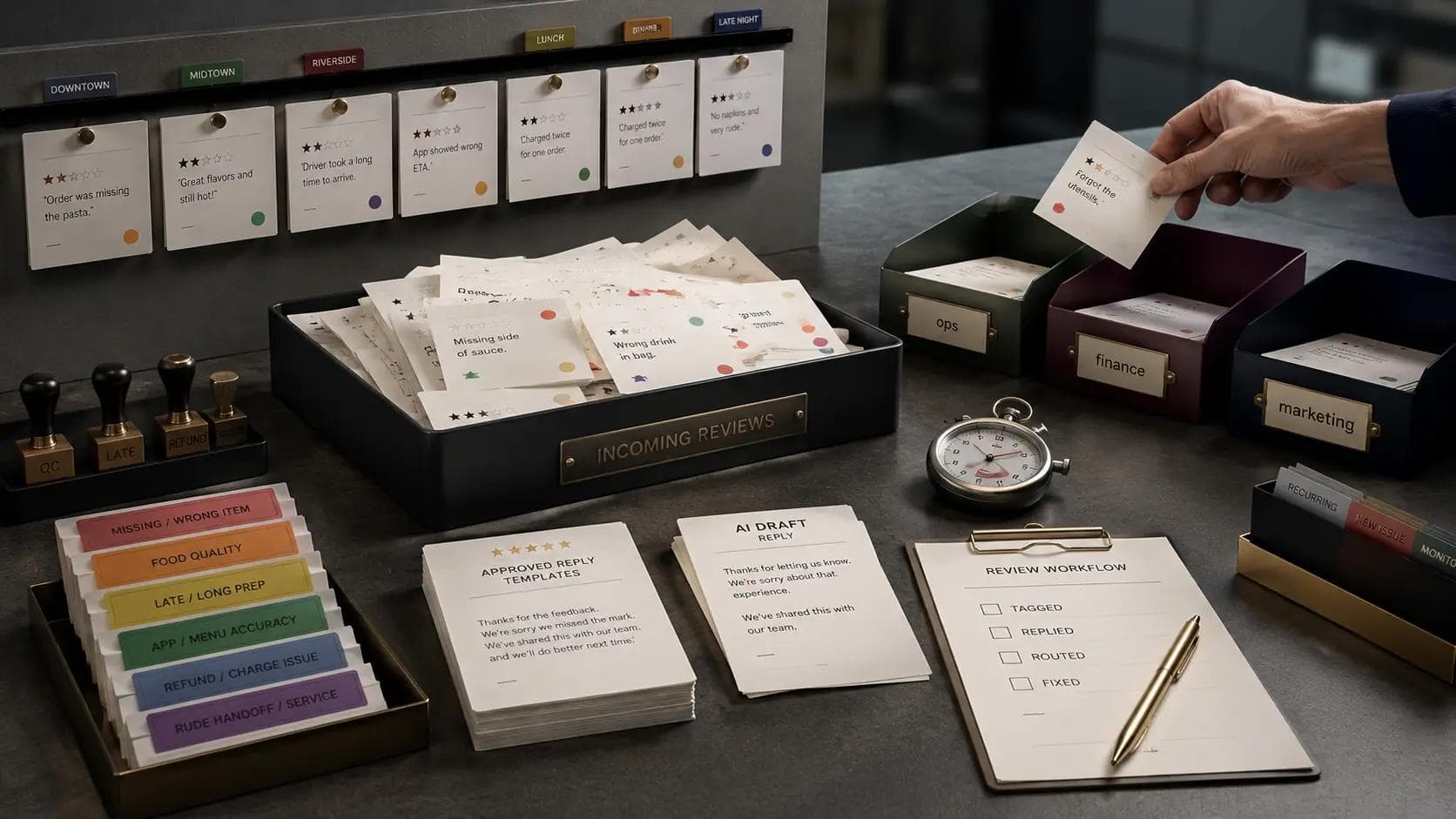
1. Pull every review into one working queue.
2. Tag the issue, store, and severity.
3. Reply with approved language, templates, or AI drafts.
4. Route the root cause to ops, finance, or marketing.
5. Track repeat issues by store and daypart.
6. Measure whether ratings, response time, and repeat complaints improve.
Bring every review into one working view
You cannot manage what you cannot see. A unified queue matters because diners do not think in channels. They think in experiences.
Voosh’s Reviews & Reputation workflow brings reviews from major delivery apps and local search into one inbox, then lets teams filter by store, brand, and rating. That alone shortens the time between “complaint happened” and “real person saw it.”
For a single-store operator, that means less tab-switching. For a 60-store brand, it means fewer blind spots.
Sort by severity, not by who yelled loudest
Not every two-star review deserves the same kind of response.
A missing item during Friday dinner rush is not the same as a vague complaint about value. A food-safety comment is not the same as “fries were cold.” If your team sorts only by star rating, you will miss what actually needs escalation.
A better rule is to tag by root cause first:
- food quality
- missing or wrong items
- late delivery or long prep
- rude handoff or service issue
- app/menu accuracy
- refund or charge problem
Voosh’s current review setup is designed to help teams surface trends instead of reading every review in isolation. That matters because the winning habit is not “respond to all reviews.” It is “spot the repeatable issue fast enough to stop the next ten.”
Reply fast with guardrails, not guesswork
Most restaurants know they should respond quickly. The harder question is how to do that without creating a tone problem, a labor problem, or a coupon problem.
This is where guardrails matter. Voosh supports AI drafts, manual replies, and preset templates, so teams can decide when speed matters most, when escalation is needed, and when a store manager should step in personally. It also ties win-back offers to rules, which matters when a response includes compensation. In one Voosh success story, a 60-location fast-casual brand centralized replies and used automated win-back offers with strict coupon caps based on store, customer type, and order value.
That is the model to copy. Fast does not mean reckless. It means structured.
If you want a simple starting SLA, use this:
- critical issue or safety concern: same shift
- refund, missing-item, or wrong-order complaint: same day
- low-star but low-risk experience complaint: within 24 hours
- positive reviews: reply selectively, but consistently enough to show the brand is present
That SLA is a practical operating recommendation, not a platform rule. The important thing is consistency.
Route root causes to ops, finance, or marketing
This is where most “review management” efforts stop too early.
A good reply can calm one guest. It cannot fix a broken modifier setup, a recurring packaging miss, or a store that quietly goes unavailable during peak. Real review management closes the loop with the team that owns the cause.
That is where Voosh’s broader stack helps. VooshGPT is built to monitor reviews, sales, downtime, disputes, and payouts across marketplaces and explain what changed, why it happened, and what to do next. The store uptime workflow adds real-time visibility into locations or menus going offline and how much delivery revenue was protected when issues were fixed quickly. That is useful because a spike in “closed,” “missing,” or “late” complaints may not be a guest-service issue at all. It may be an availability or operations problem.
In practice, the routing looks like this:
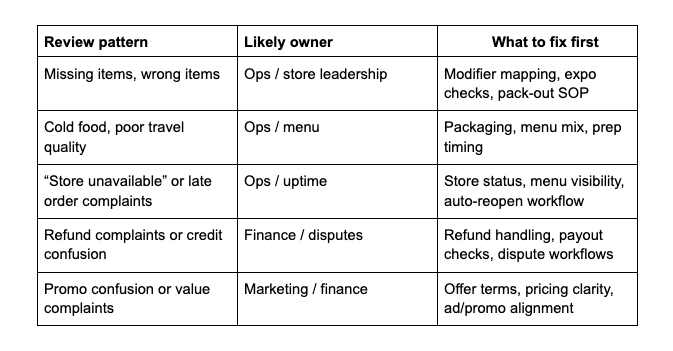
The point is simple: reviews should create action tickets, not just response threads.
Which review metrics matter more than your average star rating
A star rating matters. It just does not tell the whole story.
For operators, the better review dashboard looks at five things together:
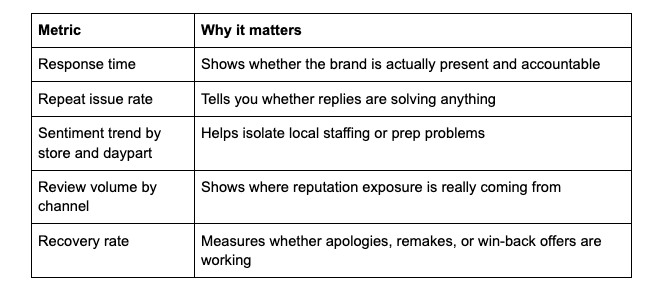
Voosh’s review capability explicitly tracks sentiment, response times, and volume in one place, while its store/daypart trend view helps teams find patterns instead of chasing isolated complaints.
That is a big shift for multi-unit teams. Instead of asking, “Which store has the worst rating?” you can ask better questions:
- Which store is slowest to respond?
- Which daypart creates the most low-star reviews?
- Which issue type is repeating even after replies go out?
- Which review themes line up with downtime or payout issues?
Those are operating questions. And operating questions are where the savings usually live.
How does Voosh help teams connect reviews to real fixes
Voosh’s edge here is not just that it helps teams answer reviews. It is that it helps them connect reviews to the rest of delivery performance.
The current Reviews & Reputation workflow centralizes review sources, supports AI drafts and templates, and surfaces trends by store and daypart. VooshGPT sits above that and combines reviews with other marketplace signals like downtime, disputes, payouts, and store performance. That lets teams see whether a review problem is really a store-quality problem, a menu availability problem, a finance issue, or a promotion mismatch.
That matters because many review spikes are lagging indicators. A surge in “missing item” complaints might trace back to one broken modifier flow. A spike in “late” complaints might align with stores going throttled or offline. A wave of “not worth it” reviews might show up right after a promotion drives the wrong order mix.
Voosh data 2025: one fast-casual brand using the review workflow replied to 7,500+ delivery reviews in 90 days across 60 locations, while using brand-safe controls and capped win-back offers to keep guest recovery disciplined. That is the kind of scale where manual review management stops being realistic.
What should independent and multi-unit teams change this week
If you run one store, start here:
- pick one place where every review gets checked
- define who owns same-day replies
- tag every low-star review by root cause for two weeks
- find the one complaint theme that repeats most
If you run many stores, start one level higher:
- create a shared severity rubric
- standardize templates by issue type
- report weekly on response time, repeat issue rate, and top complaint themes
- route one recurring review theme to the specific team that can fix it
That is how review management stops being cosmetic and becomes useful.
If you want a faster starting point, plug in [review response templates for delivery apps], compare it against [how we cut negative reviews by 25% in 45 days], and then connect the workflow back to a [restaurant dashboard for delivery operators]. Those three pieces together create a practical cluster around reputation, response quality, and operating visibility.
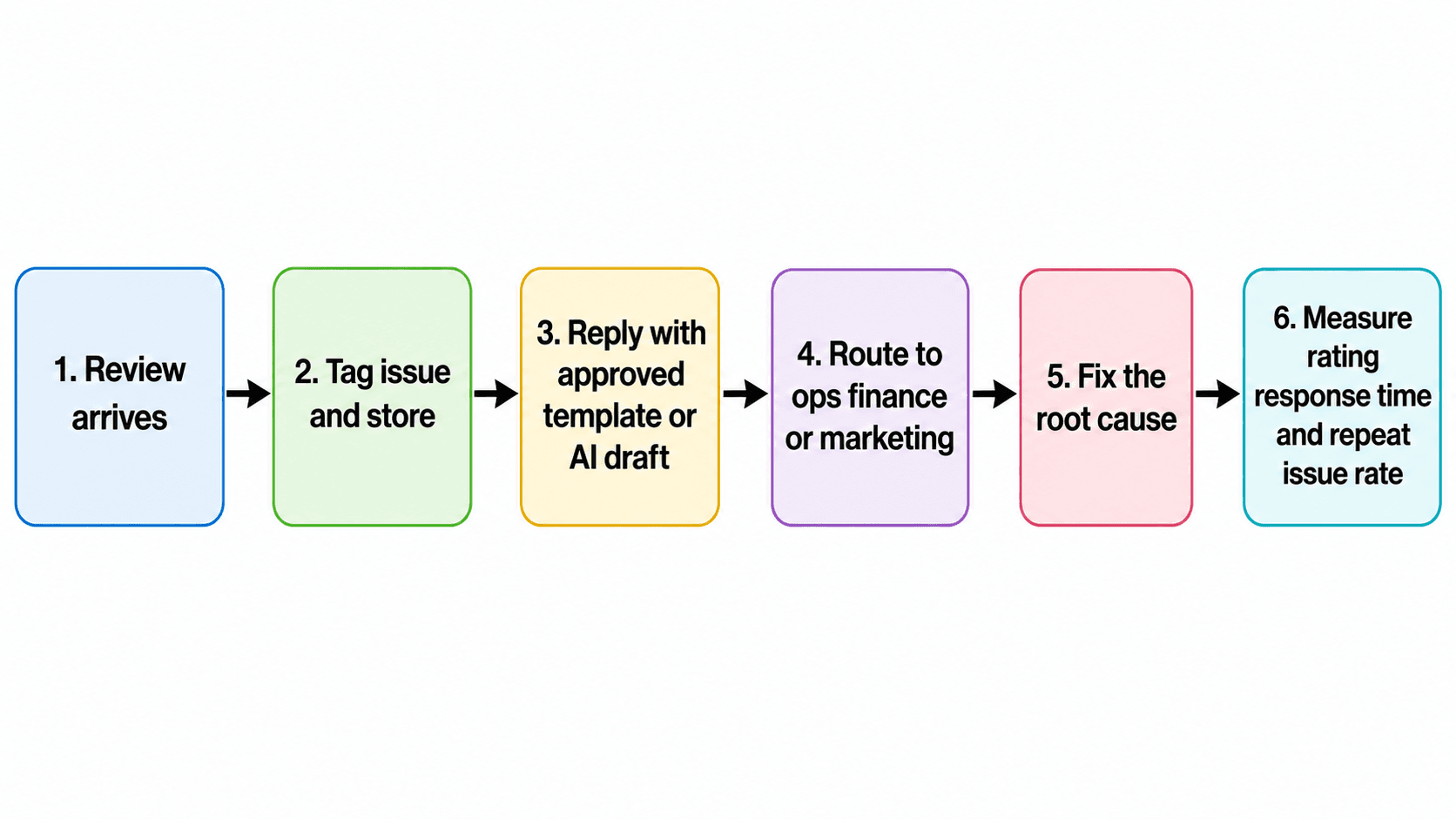
The big idea is simple. A restaurant does not win review management by typing nicer apologies. It wins by using public feedback to spot operational drag early, fix it, and keep it from repeating.
If that sounds like the kind of discipline your team wants across delivery apps and local search, Book a demo and see how Voosh helps operators turn reviews into clear next steps.