Food Delivery Packaging: A Restaurant Operator’s Guide
Summary Highlights
Learn how to choose food delivery packaging that protects temperature, texture, accuracy, and guest trust. Use the test checklist to improve every order today.
Food Delivery Packaging: A Restaurant Operator's Guide
A great meal can leave the kitchen hot, crisp, and neatly plated, then arrive 25 minutes later cold, soggy, shifted, or leaking. To the guest, that is not a packaging problem. It is a restaurant problem.
Delivery is now a regular habit, not a backup channel. The National Restaurant Association's 2025 Off-Premises Restaurant Trends report found that 37% of U.S. adults order restaurant delivery at least once a week. That makes the container, seal, label, and packing routine part of the meal itself.
What is food delivery packaging?
Food delivery packaging is the system of containers, lids, seals, insulation, labels, and packing steps that protects an order from the restaurant to the guest. Good packaging preserves temperature, texture, structure, accuracy, and trust while staying practical for staff to pack quickly and consistently.
A container may perform perfectly in a sample room and still fail during Friday dinner because it is slow to close, difficult to stack, or easy to confuse with another size.
Why does packaging affect delivery profitability?
Packaging cost is visible on an invoice. Packaging failure is scattered across refunds, remakes, low ratings, support time, and guests who quietly do not return.
A missing sauce cup or a lid that pops open can turn into the same guest complaint as a kitchen mistake. That is why packaging belongs inside your broader delivery order accuracy process.
Recent consumer research makes the upside clear. In 2025, the National Restaurant Association reported that 90% of off-premises customers would likely order a wider variety of items if upgraded packaging kept food closer to its dine-in temperature, taste, and quality. More than half of customers, including 60% of Gen Z and millennial adults, said they would pay extra for takeout or delivery when packaging helps maintain food quality.
A cheaper box that repeatedly leaks may cost more than a slightly stronger option. The real question is not “What is our price per container?” It is “What is our packaging cost per successful delivery?”
What jobs should delivery packaging do?
Keep food within safe operating controls
Packaging can slow temperature loss, but it cannot replace time-and-temperature controls. The USDA advises consumers to keep hot takeout food at 140°F or above and cold food at 40°F or below. Restaurant operating requirements can differ by jurisdiction, so follow the food code and health authority rules that apply to each location.
In Canada, federal preventive-control guidance says refrigerated food should be stored at 4°C or below. Canadian food packaging requirements also prohibit packaging that could transfer a harmful chemical to food. Material claims such as microwave-safe, compostable, PFAS-free, or recyclable should be verified with the supplier and local requirements, not assumed from appearance.
Operationally, separate hot and cold items, minimize the time between packing and pickup, and use insulated carriers where appropriate. A tight seal is not proof that food stayed at a safe temperature.
Protect texture, structure, and presentation
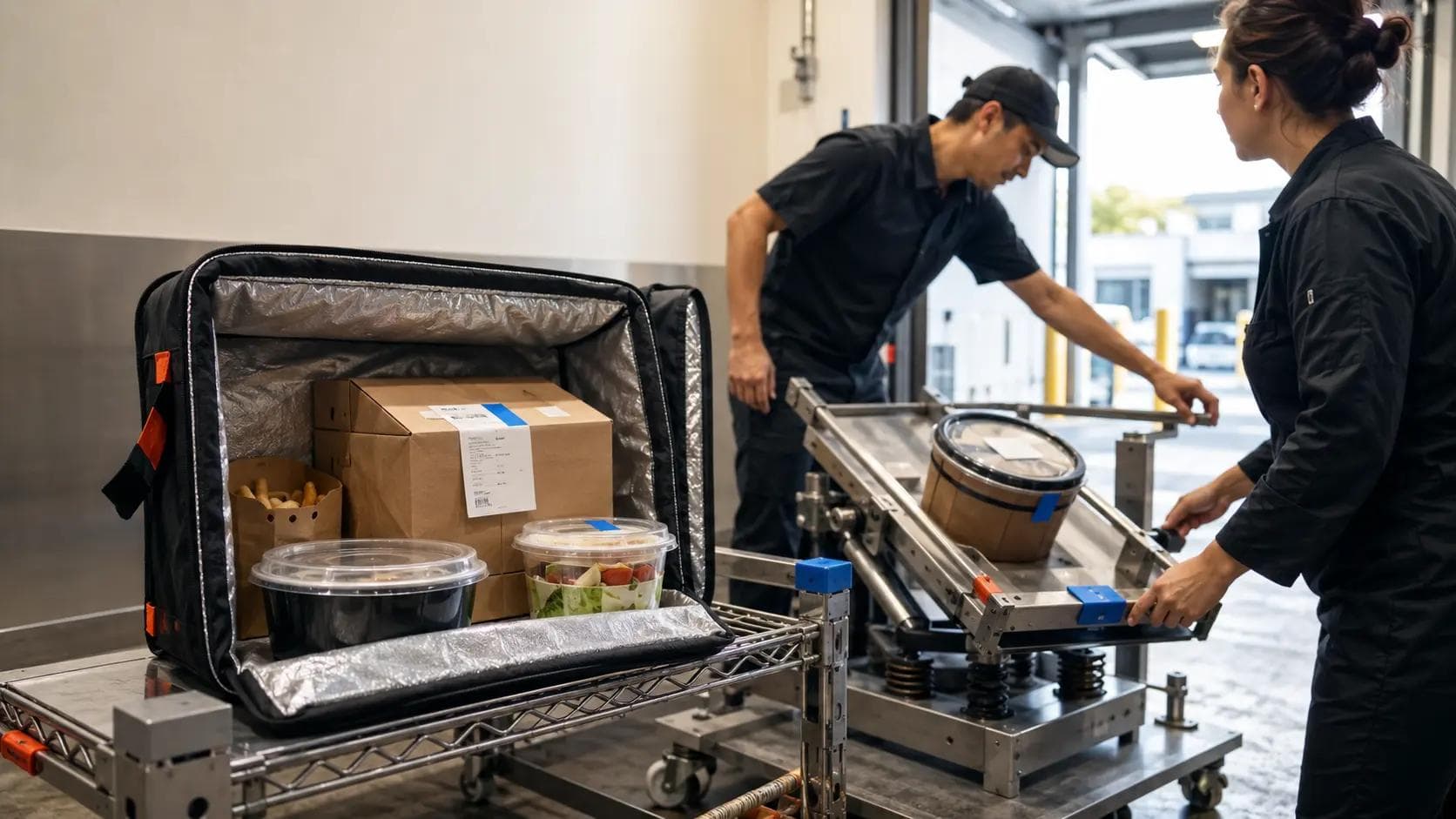
Different foods fail in different ways. Fried items trap steam and soften. Sauced dishes leak. Salads warm up. Cakes slide. Burgers compress. A single “standard” clamshell rarely protects all of them equally well.
Venting helps steam escape from crisp food. Tight, tested lids protect soups and curries. Dividers keep wet components away from dry ones. Inserts or right-sized containers reduce movement around delicate items.
Prevent leaks, movement, and tampering
A lid must survive more than a careful walk from the prep table. It may be stacked under another order, tilted during a turn, set on a car seat, or carried up several flights of stairs.
Test the complete order, not just the individual container. A leak-proof soup bowl can still tip if the bag is too wide. A drink carrier can fail when a heavier box is placed beside it. A seal can look secure but detach from a damp or greasy surface.
Make accuracy easy at the handoff
The best package is not only guest-friendly. It is staff-friendly.
Use labels that can be read quickly. Keep different container sizes visually distinct. Make sauces, drinks, and cold sides obvious during the final check. If the order has multiple bags, label them “1 of 2” and “2 of 2.”
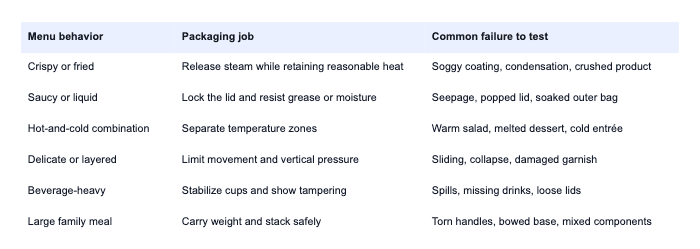
How do you match packaging to each menu item?
Start with food behavior, not material trends.
How can you test food delivery packaging in seven steps?
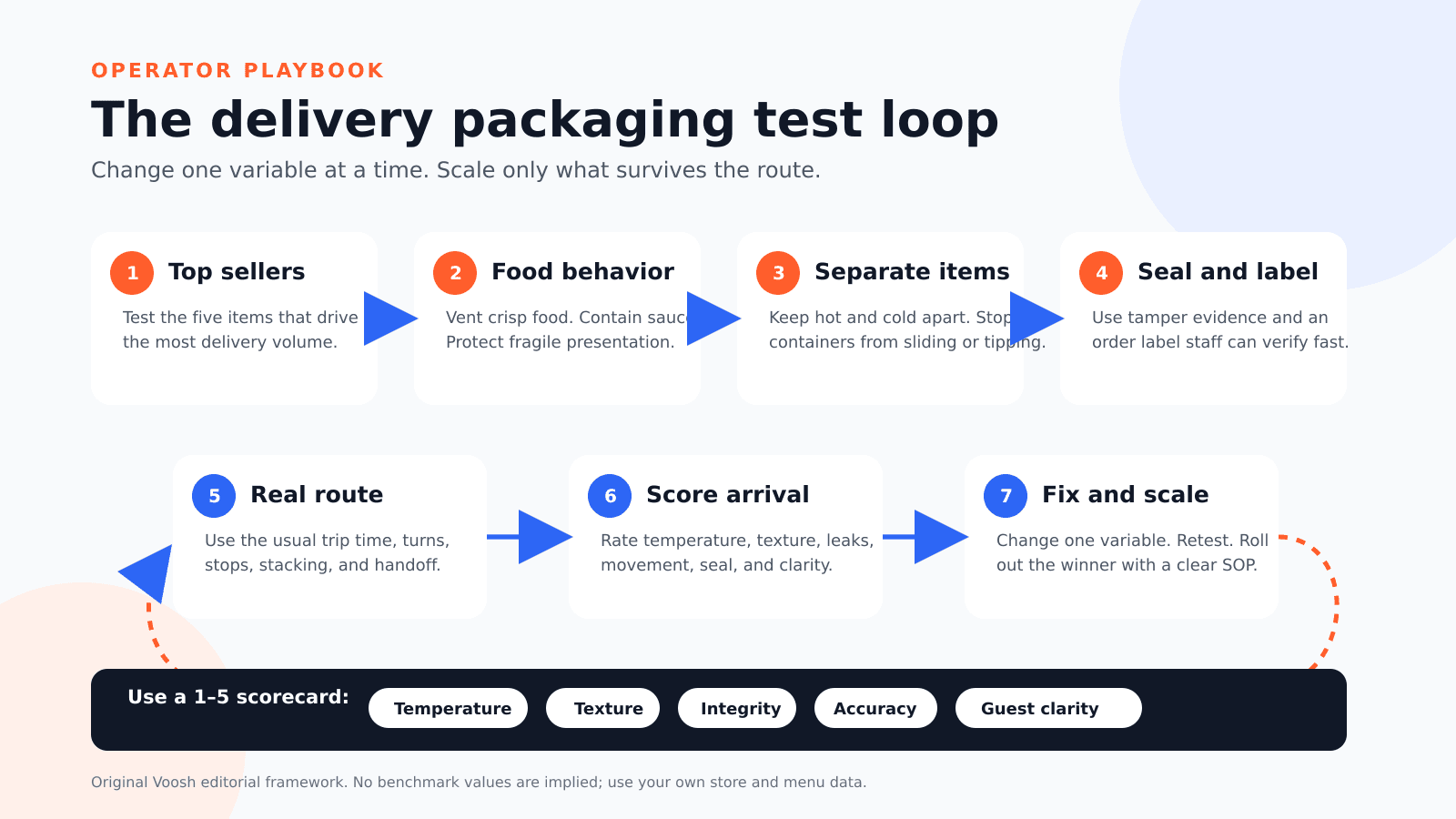
- Start with your five highest-volume delivery items. Use the real portion, sides, sauces, and drinks.
- Match each container to the food's actual behavior. Decide whether the main risk is steam, leakage, movement, crushing, or temperature transfer.
- Separate hot and cold items and stop movement. Pack the complete order exactly as the store would.
- Seal and label the order for a fast accuracy check. Include multi-bag numbering and tamper evidence where used.
- Run a real 20- to 30-minute delivery route. Include turns, stops, stacking, stairs, and a normal handoff. A stationary countertop test is not enough.
- Score temperature, texture, integrity, accuracy, and clarity. Use a one-to-five score and take photos immediately after opening.
- Change one variable, retest, and scale the winner. If you change the lid, bag, venting, and hold time together, you will not know what fixed the problem.
Run the test during more than one service period. A package that works at 2 p.m. may fail when orders wait longer during the dinner rush.
What should operators measure after rollout?
A packaging pilot needs a small scorecard. Otherwise, the loudest opinion in the room wins.
Track these measures by store and, where practical, by menu item:
- Packaging-related issue rate per 1,000 delivered orders: tagged packaging complaints divided by delivered orders, multiplied by 1,000.
- Leak or spill rate: confirmed leak/spill incidents divided by delivered orders.
- Item failure rate: complaints tied to one menu item divided by delivered orders of that item.
- Packing time: the time from item completion to sealed, labeled, ready-for-handoff status.
- Packaging cost per successful order: packaging spend plus attributable remake, refund, and service-recovery cost, divided by orders delivered without a packaging failure.
- Low-rating language: repeated words such as “soggy,” “spilled,” “cold,” “open,” “crushed,” or “missing drink.”
Watch delivery prep time alongside packaging changes. A stronger container is not an improvement if it adds two minutes at the station and creates a pickup queue.
Keep attribution honest. A “cold food” review may point to packaging, a long courier wait, early packing, or a long trip. Use the comment as a signal to investigate, not instant proof of the cause.
How do multi-unit teams scale packaging without losing consistency?
A packaging decision made at headquarters can break at store level if operators cannot source, store, or use the item consistently.
Treat rollout as part of restaurant delivery operations management, with clear ownership and approved substitutions.
Use a simple rollout structure:
- Pilot at two or three locations with different order volumes and courier patterns.
- Photograph the correct pack for each priority item.
- Document container, lid, liner, seal, label, and bag placement.
- Set an approved substitute for supply shortages.
- Train with a complete mock order, not an empty container.
- Audit during a real peak period.
- Review complaints and packing time after two and four weeks.
Avoid a vague instruction such as “use the new bowl.” Staff need to know which items go in it, how full it should be, which lid fits, where the label goes, and whether it can be stacked.
How can review data expose a packaging problem?
Packaging failures often appear first as scattered guest comments. One store gets “fries were soggy.” Another gets “soup spilled in the bag.” A third gets “seal was already open.” Each comment looks small until the pattern is visible across locations.
That is why reviews should become store-level operations signals, not stay trapped inside separate marketplace portals.
Voosh's restaurant review management brings DoorDash, Uber Eats, Grubhub, Google, and Yelp reviews into one inbox. Teams can filter by brand, store, or rating, while Voosh surfaces trends by store and daypart and flags issues for operations follow-up.
Voosh does not replace the route test or tell you which container to buy. It helps reduce the blind spot between what guests report and what operators investigate.
A practical weekly review looks like this:
- Search recent low-rating comments for packaging language.
- Group the comments by store, daypart, and menu item.
- Compare them with prep and handoff conditions.
- Recreate the order and run the route test.
- Change one variable and monitor whether the pattern falls.
That loop is more useful than replying to each complaint and moving on.
What can you improve in the next 30 days?
Week 1: Build the baseline. Choose five high-volume items. Pull four weeks of relevant complaints, refund reasons, packing times, and container costs. Photograph the current pack.
Week 2: Test alternatives. Get supplier samples. Run the real route with the current package and one alternative. Score both against the same criteria.
Week 3: Pilot in stores. Select locations with different volumes. Train the exact packing SOP and track packing time, spills, and guest comments.
Week 4: Decide and document. Roll out only if the alternative improves the failure rate without creating a serious station-time or cost problem. Publish photos, approved substitutions, and an audit date.
You do not need perfect packaging across the entire menu in 30 days. You need a repeatable process that improves the items guests order most.
Make packaging a measurable part of delivery operations
Food delivery packaging is not decoration and it is not a one-time purchasing decision. It is an operating system that sits between the kitchen and the guest.
Start with the food, test the full route, measure what arrives, and use guest feedback to find patterns across locations. The right answer may be a vented lid, a smaller bag, a stronger seal, a clearer label, or a shorter hold before pickup. Data will tell you which change actually worked.
If your team is still checking reviews one marketplace and one store at a time, Voosh can bring those signals into one place and help operators see where delivery issues repeat. Book a demo to see how the workflow can support your team.
Catch up on other editions

Voosh Achieves SOC2 Compliance, Enhancing Data Security for Clients Nationwide

Uber Eats Store "Currently Unavailable"? Why It Happens and How to Fix It